Winter carPart 1 of 4 · The Winter Car
Can You Leave a Jump Starter in Your Car in Winter?
You keep a jump starter for the coldest morning of the year. The manuals say that cold is also where a lithium pack's storage rules start to bite.
As an Amazon Associate, BlackBox earns from qualifying purchases. Some links go to a maker's own store through the Awin affiliate network, and we earn a commission on those too. Neither changes your price or which product we pick. Picks are never paid placements. How this works
It's 6 a.m., the car has sat outside all night, and the jump starter has been in the trunk since October. Whether it wakes up depends on a few lines in its manual.
If the starter has to live in the car all winter, buy the Autowit SuperCap 2. It has no battery to drain: Autowit rates it to work at -40°C and says it can sit drained for years, then charge from your car battery in a few minutes. Autowit lists no storage temperature, so read its manual.
If you'll keep it in the house and carry it out, a lithium pack brings its own charge, and the NOCO Boost GB40 comes with the clearest rules: never stored below -4°F, recharged between 32°F and 104°F, topped up every 4 to 6 months.
The top-up calendar further down shows the month each pack needs its mid-winter charge.
What we recommend
 Our pick for a car that sits out all winterMost people should start hereNo battery to drain or top upAutowit SuperCap 2Check price
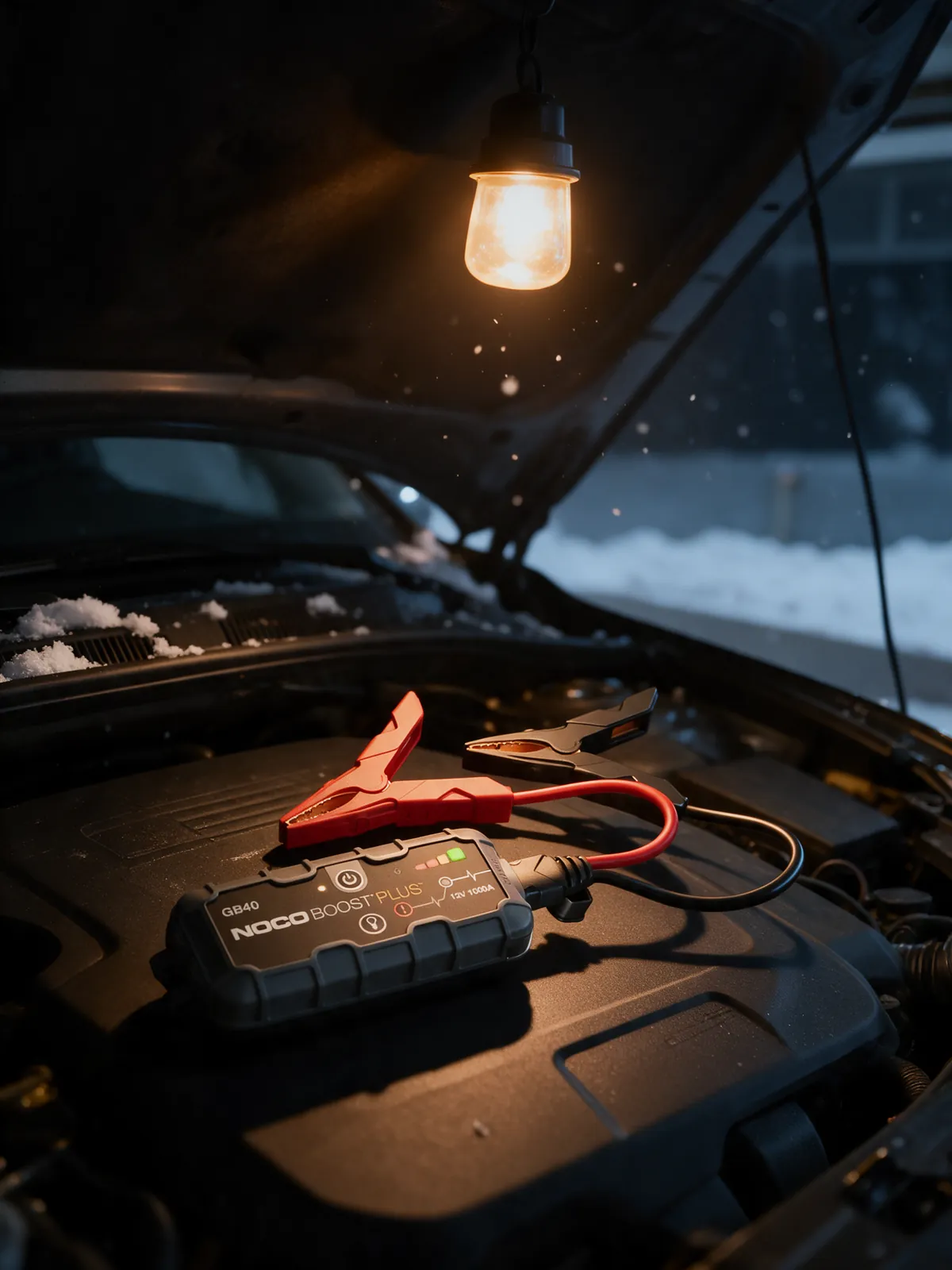 If you'll store it indoorsCarries its own charge, with the clearest storage rulesNOCO Boost GB40Check price
- If you want a screenA display that shows the battery level before you need itFanttik Potent T10Check price
In this guide9 sections
What the makers say about winter in the car
A manual can give two cold limits, one for storage and one for use. For a pack that lives in the car, storage is the one that counts.
NOCO is the most specific. Its FAQ says no Boost pack should be stored below -4°F or above 122°F "for any reason", because storage outside that range can damage multiple crucial components. The GB40's user guide adds that the pack "is intended to be stored indoors when not in use", and it prints a daily average of 0°C to 25°C (32°F to 77°F) beside its storage range.
GOOLOO's FAQ gives its packs one range for use and storage, -4°F to 140°F. Fanttik lists a working temperature of 5°F to 113°F for the Potent T10, and no storage range on its product page.
Charging has a narrower window. NOCO says to recharge Boost packs between 32°F and 104°F, so a pack sitting in a car below freezing is outside that window until you bring it in.
Each lithium pack comes with a calendar. The supercapacitor comes with none.
A supercapacitor starter works another way. The Autowit SuperCap 2 keeps no charge between uses; it takes a quick charge from your car's weak battery when you need it. Autowit rates it to work at -40°C, which is also -40°F, and to resist 70°C (158°F).
| Pack | Cold limit (kind) | Top-up | Source |
|---|---|---|---|
| NOCO Boost (GB40, GB70) | Stored no colder than -4°F | At least every 4 to 6 months | NOCO FAQ |
| GOOLOO packs | -4°F for use and storage | Every 3 months | GOOLOO FAQ |
| Fanttik Potent T10 | Works to 5°F; storage range none listed | Every 2 to 3 months | Fanttik product page |
| Autowit SuperCap 2 | Works to -40°C (-40°F); no storage range listed | None: it charges from the car before each start | Autowit product page |
Our pick: Autowit SuperCap 2
Our pick for a car that sits out all winter
No battery to drain or top up
Autowit SuperCap 2
A batteryless starter that charges from your car's own battery in a few minutes. Autowit rates it to work at -40°C and says it can be stored drained for years.
- Type
- Supercapacitor, no battery
- Works down to
- -40°C (-40°F)
- Top-up schedule
- None
- Storage
- Drained, for years
- Storage range
- None listed
- Engine rating
- 7.0L gas, 4.0L diesel
Specs: Autowit product page
It has no charge to keep. Autowit says it can be stored drained for a period spanning years and needs only a few minutes to charge, so there is no charge level to watch between November and March. Its page lists no storage temperature.
It has the widest working range here. Autowit rates it to work at -40°C. NOCO and GOOLOO give a storage floor of -4°F, and Fanttik gives a working floor of 5°F. Autowit lists no separate storage range; its page says the pack can be stored drained for years.
No charge to keep means no charge to lose in a cold trunk.
If the starter lives in the car, buy this one. If it can live in the house, the GB40 brings its own charge.
Flaws but not dealbreakers
- It borrows its charge from your car battery, so that battery needs some charge left in it. Our supercapacitor guide covers what to do when it is completely flat.
- Plan on a few minutes of charging at the car before each start. It doesn't arrive ready the way a charged lithium pack does.
- Its diesel rating is 4.0L. For a bigger diesel, size the starter with our diesel guide.
If it can live in the house: NOCO Boost GB40
If you'll store it indoors
Carries its own charge, with the clearest storage rules
NOCO Boost GB40
A compact lithium pack that needs nothing from the car before it boosts. NOCO's guide says to store it indoors, which makes it a pack you carry out, not one that lives in the car.
- Engine rating
- 6.0L gas, 3.0L diesel
- Storage range
- -4°F to 122°F, indoors
- Recharge between
- 32°F and 104°F
- Charge held
- 70% for up to a year
- Top-up
- At least every 4 to 6 months
- Recharge time
- 3 h on a 2A charger
Specs: NOCO user guide and support FAQ
It brings its own charge. NOCO says the GB40 jump starts 12V lead-acid batteries down to 2 volts, and it needs nothing from the car before it boosts.
NOCO spells out every storage rule. The support FAQ says all Boost packs hold 70% of their rated capacity for up to a year, and NOCO still recommends a charge at least every 4 to 6 months.
If you'll bring it inside, buy the GB40. If you want to read the exact charge on a screen, look at the Fanttik.
Flaws but not dealbreakers
- NOCO's guide says to store it indoors. If you won't bring it in, buy the Autowit.
- Its diesel rating stops at 3.0L. NOCO rates the bigger GB70 to a 6.0L diesel.
- The charge LEDs read in 25% steps, so you see a band, not an exact figure.
If you want to see the charge: Fanttik Potent T10
 Image: Fanttik
If you want a screen
A display that shows the battery level before you need it
Fanttik Potent T10
An 1800A lithium pack with a built-in display for voltage, battery level and status. Fanttik sizes it for a backpack or a cup holder: "not the kind of jump starter you leave in the trunk and forget about."
- Peak current
- 1800A
- Engine rating
- 7.0L gas, 5.0L diesel
- Working range
- 5°F to 113°F
- Storage range
- None listed
- Top-up
- Every 2 to 3 months
- Battery
- 12000mAh (44.4Wh)
Specs: Fanttik product page
The screen settles the "is it charged" question. Fanttik says the display shows real-time voltage, battery level and operating status, so the mid-winter check is a glance.
It reaches further than the GB40. Fanttik rates it for 7.0L gas and 5.0L diesel engines, against NOCO's 6.0L and 3.0L for the GB40.
If you'll carry a pack and want to read its charge, buy this one.
Flaws but not dealbreakers
- Its 5°F working floor is the narrowest cold limit here. Keep it inside on the coldest nights.
- Fanttik asks for a charge every 2 to 3 months, the shortest interval of the three lithium packs.
How often to check and top it up
For a lithium pack kept indoors, winter care is a few dates in a calendar.
Charge it full before the first freeze. NOCO's guide says an unused pack discharges over time and must be recharged before use.
Set a reminder at your maker's interval. NOCO says at least every 4 to 6 months, GOOLOO every 3, Fanttik every 2 to 3. Charged in early November, a Fanttik is due again in January or February, a GOOLOO in February, and a NOCO between March and May.
Charge it indoors. NOCO says to recharge Boost packs between 32°F and 104°F. A pack that has been out in a freezing car should warm up inside before it goes on the charger.
Read the level when you check. The GB40 shows its charge on four LEDs in 25% steps. The T10's display shows the battery level.
Look at the case every time. NOCO says to stop using the pack and contact NOCO if it is excessively hot, gives off an odor, or is deformed or cut.
Never jump a frozen car battery. NOCO's guide says not to jump start a frozen battery, whatever the pack.
Who this is for, and who should skip it
A car parked outside through a hard winter. Look at the Autowit. It is the one pack here with a -40°C working rating and no charge to keep. Check its manual for storage limits first.
A garage-kept car, or a driver who brings a bag in every night. A lithium pack kept indoors suits you. The GB40 has the clearest rules; the T10 shows its charge on a screen.
A diesel truck. Check the engine against the maker's diesel rating: 3.0L for the GB40, 4.0L for the Autowit, 5.0L for the T10.
A car that sits for weeks without being driven. The jump starter is only the backup. A battery maintainer keeps the car battery itself from going flat; our winter storage guide covers which one.
How we picked
Every rule on this page comes from the makers' own records: NOCO's GB40 user guide and its Boost support FAQ, GOOLOO's FAQ, Fanttik's Potent T10 product page and Autowit's SuperCap 2 product page.
We looked for three things. A published cold limit, because that decides whether the pack can stay in the car. A published top-up interval, because that decides how often you have to remember it. And an engine rating that matches yours. The Autowit is the default because it is the only one here with no charge to keep. The GB40 and the T10 are for readers who will keep a pack indoors and carry it out.
- Picks
- 3
- Sources cited
- 5
- Records checked
- November 1, 2026
Questions people ask
How often should you check a jump starter that sits in the trunk all winter?
At your maker's interval, plus once before the first freeze. NOCO recommends a charge at least every 4 to 6 months, GOOLOO every 3 months and Fanttik every 2 to 3. Over one winter that means a mid-season charge for a GOOLOO or Fanttik pack, done indoors: NOCO says to recharge between 32°F and 104°F. NOCO's GB40 guide also says the pack is intended to be stored indoors, so the trunk is a place to carry it, not keep it.
Is it bad to leave a lithium jump starter in a cold car?
Below its storage floor, yes. NOCO says Boost packs should not be stored below -4°F, and that storing them outside their range can damage multiple crucial components. GOOLOO lists -4°F for its packs too. NOCO's GB40 guide adds that the pack is intended to be stored indoors when not in use.
Can you leave a compact jump pack in a diesel truck all winter?
The same storage rules apply, plus the engine rating. NOCO rates the GB40 to a 3.0L diesel and the GB70 to a 6.0L diesel; Autowit rates the SuperCap 2 to 4.0L. Our diesel guide covers sizing a pack for a bigger truck in the cold.
Does a supercapacitor jump starter work in freezing weather?
Autowit rates the SuperCap 2 to work at -40°C, which is also -40°F. It charges from your car's weak battery, so it depends on that battery having some charge left. Our supercapacitor guide covers what to do when it doesn't.
What temperature is too cold to charge a jump starter?
For NOCO's Boost packs, anything below 32°F: NOCO gives a charging window of 32°F to 104°F. Bring the pack inside and let it warm up before you plug it in.
Sources
- NOCO - Boost support FAQ (storage -4°F to 122°F, recharge 32°F to 104°F, 70% for a year, charge every 4-6 months, engine ratings)
- NOCO - GB40 user guide (store indoors, storage range and daily average, recharge times, frozen-battery warning)
- GOOLOO - FAQs (operating and storage -4°F to 140°F, recharge every 3 months)
- Fanttik - Potent T10 product page (working temperature 5°F to 113°F, charge every 2-3 months, display, engine rating)
- Autowit - SuperCap 2 product page (works at -40°C, resists 70°C, stored drained for years, engine rating)
Free checklist
Before a jump starter rides out the winter
Seven checks, each from a maker's own page. Screenshot it before the first freeze.
From Can You Leave a Jump Starter in Your Car in Winter?, blackboxsupplies.com
Want the next list?
New BlackBox field notes: the gear worth owning, whose numbers they are, and the flaw on each. No spam. Unsubscribe any time.
- No spam
- One email a week
- Unsubscribe anytime