
Jump Starters
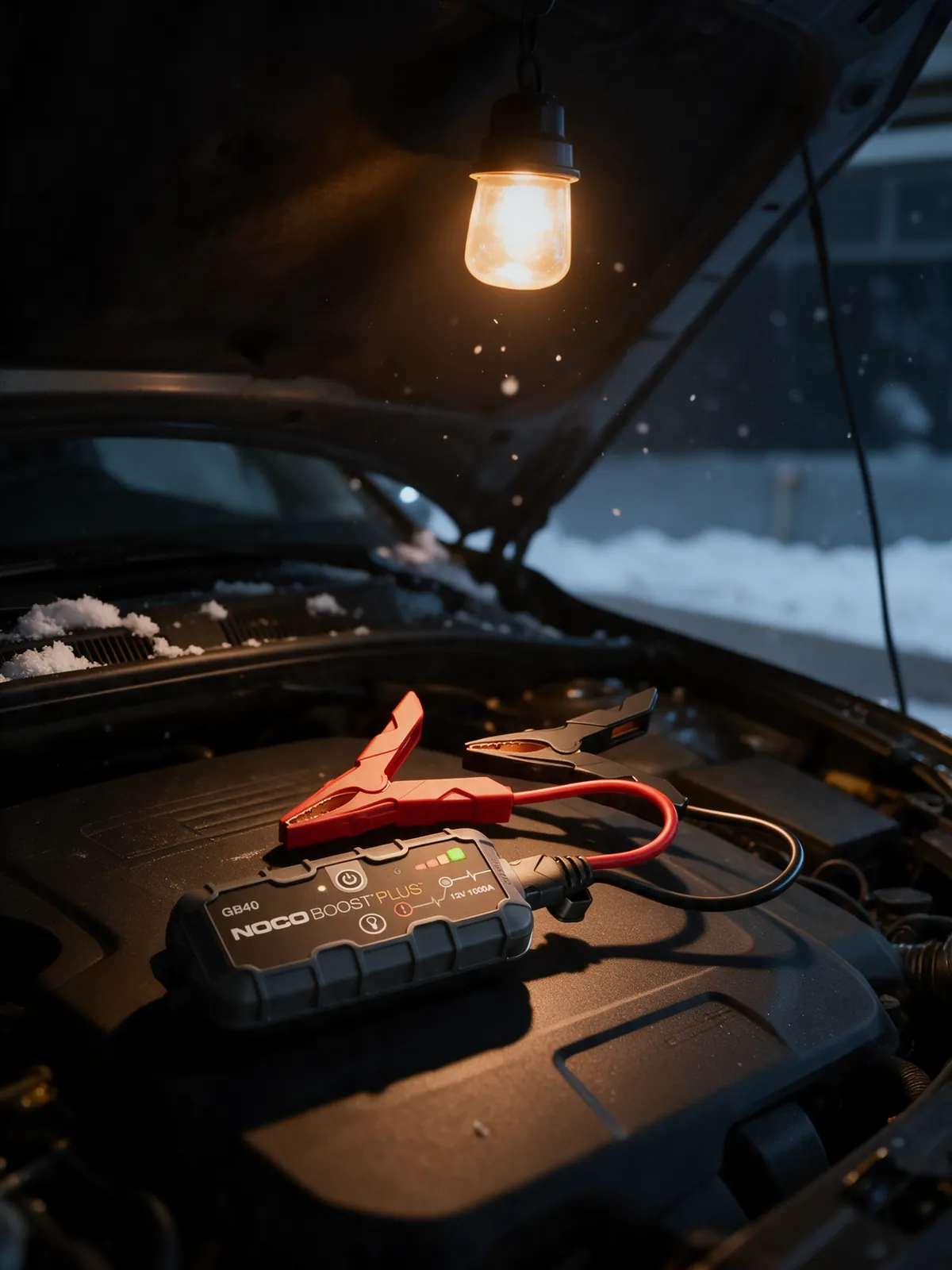
NOCO Boost GB40 1000A UltraSafe Lithium Jump Starter
$80-100
Compact 1000A 12V lithium jump starter that lets a driver jump their own dead battery with no second car.
Affiliate linkA supercapacitor jump starter holds no charge of its own — it borrows a little from your dying battery, then cranks. That genuinely fixes the way lithium packs fail (dead in the glovebox), but it trades that problem for a different one. Here's what owners actually report, and who should buy which.
Yes, with a real condition attached. A supercapacitor pack has no lithium cell to self-discharge, so it survives months in a hot or freezing car — the exact failure that kills forgotten lithium packs. But it holds charge only briefly, so it must borrow charge before each crank: a few minutes off your own weak battery (hands-on reviews timed about 3-6), or roughly 10 minutes from USB. If your battery is stone dead at 0V, it cannot self-charge at all and you need a power bank or another car.
Disclosure · As an Amazon Associate, BlackBox Supplies earns from qualifying purchases — at no extra cost to you. See our full disclosure.
Here is the moment that sends people to this page. The car is dead, you reach for the jump starter you bought for exactly this — and the jump starter is dead too. It has been in the glovebox since last winter.
That is not bad luck, it is the documented failure mode of lithium jump starters, and the makers say so themselves. NOCO recommends charging its Boost packs, the GB40 included, at least every 4-6 months. On the GOOLOO GP2000, owners report the unit failing to recharge or start after long idle storage unless it is topped up roughly every three months, and units left uncharged can fail to recover within about two years.
So the real-world requirement of a lithium jump starter is a calendar reminder every few months, for a device you hope to never use. A supercapacitor pack is the industry's answer to precisely that, and the reason it can make that claim is that there is no battery inside to go flat.
$80-100
Compact 1000A 12V lithium jump starter that lets a driver jump their own dead battery with no second car.
Affiliate link
$60-80
Compact ~1.2 lb 2000A 12V lithium jump starter that doubles as a USB power bank.
Affiliate linkA supercapacitor stores energy in an electric field rather than a chemical reaction. That gives it the opposite personality to a lithium cell: it charges in minutes instead of hours, it does not degrade the way a battery does with cycles, and it shrugs off temperature — the Autowit SuperCap 2 is rated from -40F to 158F. The trade is capacity. A capacitor of this size holds only enough energy for a short, violent burst, which happens to be all an engine start needs: owners describe roughly an 800A crank window lasting about 5-10 seconds.
Because it holds so little, it does not arrive charged. You clamp it to the dead battery and it pulls what it needs from whatever charge is left — hands-on reviews timed about 3-6 minutes from the car's own weak battery, or roughly 10 minutes from a USB source. One owner reports bootstrapping it from a battery down at about 5V, which is well below the point where the engine will do anything but click. Then you crank.
That is the whole trick, and it is a genuinely clever one: your battery usually is not empty, it is just too weak to deliver the huge current a starter motor demands. The capacitor borrows the energy slowly and gives it back fast.

$90-130
Ideal leave-it-in-the-car unit that's always ready.
Affiliate linkThis is the part the marketing does not lead with, and it is the reason this page is not a straight recommendation. A supercapacitor pack has no reserve of its own. If the battery is truly at 0V, there is nothing to charge from and the device cannot help you unaided — owners in that situation have to feed it from a USB power bank or another car's battery first. A lithium pack, if you kept it charged, does not care about any of that.
There is a second consequence of storing energy in a field rather than a chemical: it leaks. How fast is thinly documented: one owner, on a first-generation unit, estimates usable charge lasts roughly 10 to 30 minutes. You cannot charge it in the driveway and carry it around ready to go — it has to be charged immediately before each attempt. And if an attempt fails, you recharge before trying again, which matters more than it sounds: one owner found it insufficient to crank a cold 2.5L diesel at 15-17F despite the unit's 4.0L-diesel rating, and every miss meant another wait.
So the honest summary of the trade is this. Lithium fails on maintenance — it dies because you forgot it. Supercapacitor fails on preconditions — it needs residual voltage or a USB source, and it needs your engine to be within its cranking ability on the first or second try. Neither is strictly better; they fail in different directions.

$50-$70
It's bag gear, not pocket gear, given the size and weight.
Affiliate link| Supercapacitor (Autowit SuperCap 2) | Lithium (NOCO GB40 / GOOLOO GP2000) | |
|---|---|---|
| Ready after months of storage | Yes — no cell to self-discharge or swell | Only if topped up; NOCO says every 4-6 months for the GB40, GP2000 owners about every 3 |
| Works with a 0V battery | No — needs residual voltage, USB, or another car | Yes — it carries its own charge |
| Holds charge once charged | No — it leaks; one owner (first-gen unit) estimates 10-30 minutes | Yes — GB40 owners report about 15-20 gas starts per charge |
| Temperature tolerance | Rated -40F to 158F; heat does not degrade it | NOCO rates the GB40 to -4F; one owner thread reports weak starts at 10F. Hot-car storage above ~140F degrades or swells cells |
| Repeat attempts | Recharge between each try | GB40 about 15-20 starts; GP2000 about 4-5 per full charge |
| Approximate price | $90-130 | GB40 $80-100 / GP2000 $60-80 |
$90-130
Ideal leave-it-in-the-car unit that's always ready.
Affiliate link$80-100
Compact 1000A 12V lithium jump starter that lets a driver jump their own dead battery with no second car.
Affiliate link$60-80
Compact ~1.2 lb 2000A 12V lithium jump starter that doubles as a USB power bank.
Affiliate link
$45-70
Thick 1-gauge, 800-amp booster cables in a 25-foot length with heavy clamps and a carry bag.
Affiliate linkWe did not test these packs. We do not crank engines on a bench and we will not pretend otherwise. What we did was read the real evidence base for each product and report what owners actually say, including where it contradicts the marketing.
You should know that the evidence base for the supercapacitor category is thinner than for the lithium packs, and that is a real caveat rather than a formality. The Autowit figures here come from independent hands-on reviews, an overlander owner thread, and forum and Q&A reports — several first-hand accounts, not the thousands of reviews behind a NOCO or GOOLOO pack. The 2.5L diesel result is one owner's experience, not a pattern we can call typical. Treat the long-life claim with the same caution: the maker cites a 10-20 year lifespan and thousands of cycles, long-term owner data is still thin, and the unit carries a one-year warranty.
Prices are approximate and move with sales, so confirm the current listing before you buy.
Yes, but 'batteryless' means it has no stored charge to rely on until you charge it at the car. It pulls energy from your weak battery in a few minutes (hands-on reviews timed about 3-6), or roughly 10 minutes from USB, then delivers it back as a short high-current burst — owners describe about 800A over roughly 5-10 seconds. The engine start is a brief, huge demand, which is exactly what a capacitor is good at.
Then a supercapacitor pack cannot help you on its own. It needs residual voltage to charge from, and a stone-dead battery gives it nothing. Owners in that case charge it from a USB power bank or another car's battery first. This is the main reason to carry a power bank alongside it — or to buy a lithium pack instead, since a charged lithium unit does not need anything from your battery.
No — and this is the most common misunderstanding about them. It leaks its charge (one owner, on a first-generation unit, estimates 10 to 30 minutes), so it must be charged right before each crank. What it does do is sit uncharged in your car for months without degrading, which is the opposite of a lithium pack's storage behavior.
Be cautious. The Autowit SuperCap 2 carries a 4.0L diesel rating, but one owner reported it was not enough to crank a cold 2.5L diesel at 15-17F, and each failed attempt means recharging before the next. For diesels — especially in the cold — a high-amp lithium pack sized by the manufacturer's engine-size rating is the more dependable choice.
On paper the capacitor, because there is no cell to degrade — the maker cites a 10-20 year lifespan and thousands of cycles. In practice, long-term owner data on these is still thin and the warranty is one year, so treat that as a claim rather than a proven result. Lithium packs are better documented: owners of both the GB40 and GP2000 report roughly 3-5 years when they keep them topped up, with cell swelling or lost capacity as the usual end.
Research-driven: our picks come from verified manufacturer specs and long-term owner feedback. How we work: our methodology.
The car, power, cooling, and work-utility gear worth owning — with the honest catch on each. One genuinely useful email a week. No spam, no fake reviews, unsubscribe anytime.