
Power & Charging
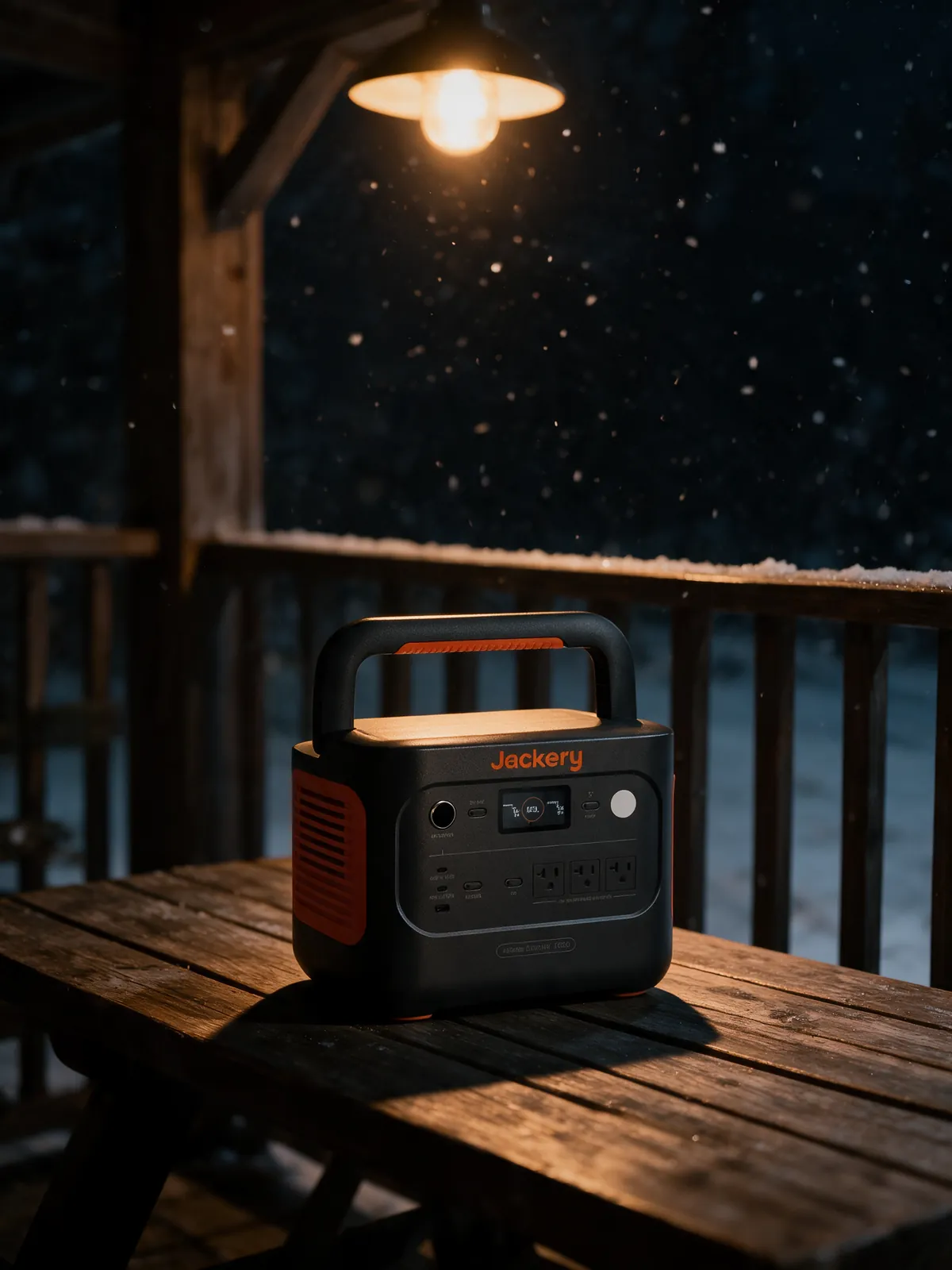
Jackery Explorer 1000 v2 Portable Power Station
$449-799
1070Wh LiFePO4 portable power station with 1500W AC output.
Affiliate linkA winter outage is when you need a power station most and when it is hardest on one. Four picks by size, the cold limit that decides where you can keep it, and the arithmetic of how long it lasts.
For a winter outage the Jackery Explorer 1000 v2 is our all-round pick of the four: 1,070Wh and 1,500W, which at a 100W load is about ten hours before conversion losses. Step up to the BLUETTI AC180 for more output, down to the EcoFlow RIVER 2 Pro for compact, or to the Anker SOLIX C300 for phones and lights only. Keep it indoors: Jackery's own page says it will not charge below 32°F.
Disclosure · As an Amazon Associate, BlackBox Supplies earns from qualifying purchases — at no extra cost to you. See our full disclosure.
A winter outage asks for the same few things every time: light, phone charging, a router or radio, perhaps a refrigerator, and often a medical device. A power station is a battery with outlets, so the buying rule is simple. Watt-hours (Wh) tell you how long it runs; watts (W) tell you what it can run at once. A unit can pass one test and fail the other.
The arithmetic is just division, and it flatters the real world, because conversion losses take a share: capacity in watt-hours divided by the load in watts gives hours. On the Jackery's 1,070Wh, a 100W load runs about 10.7 hours, and a 1,500W load about 0.7 hours, or 43 minutes. That is arithmetic, not a measured runtime from Jackery.
| Pick | Capacity and chemistry | Output | Ports and recharge |
|---|---|---|---|
| Jackery Explorer 1000 v2Check price on Amazon → | 1,070Wh LiFePO4 | 1,500W AC (3,000W surge) | 3 AC, USB-C 100W and 30W, USB-A, 12V; about 1 hour recharge |
| BLUETTI AC180Check price on Amazon → | 1,152Wh LiFePO4 | 1,800W AC (2,700W peak) | 4 AC, USB-C 100W, 12V/100W, wireless pad; 0 to 80% in 45 minutes |
| EcoFlow RIVER 2 ProCheck price on Amazon → | 768Wh LiFePO4 | 800W AC (1,600W X-Boost) | 4 AC, USB-C 100W, car port; 0 to 100% in about 70 minutes |
| Anker SOLIX C300Check price on Amazon → | 288Wh LiFePO4 | 300W AC (600W surge) | 3 AC, two 140W USB-C, 120W car; 8 ports; 0 to 80% in 50 minutes |
Most power-station advice is written for summer camping. In winter the question is where you can keep it. Jackery's own page for the Explorer 1000 v2 lists a charge temperature of 32 to 113°F and a discharge temperature of 14 to 113°F. So it will run down to 14°F but will not charge below freezing. A unit left in an unheated garage on a 20°F night can supply power and cannot be topped up from the wall or a solar panel until it warms.
That is Jackery's number for Jackery's unit. We did not read the cold limits for the BLUETTI, the EcoFlow or the Anker, so check each maker's page for the exact model. If a winter spec is missing, assume the unit belongs indoors. We have a longer guide on whether power stations work in cold weather.
The practical rule for any of them: keep it inside, charged, near where you will use it, and plug in what you need there.
$449-799
1070Wh LiFePO4 portable power station with 1500W AC output.
Affiliate linkThe Jackery 1000 v2 is the pick for a household that wants to keep the essentials going. The two numbers set the limits: it can run appliances up to 1,500W, for as long as the 1,070Wh lasts. Its page lists a recharge of about 1.58 hours from the wall adapter.
The BLUETTI AC180 is the step up when you need output headroom: 1,800W continuous and 2,700W peak, with 1,152Wh of capacity. It suits a larger appliance or several at once, and its recharge is fast, 0 to 80% in 45 minutes per our catalogue.
The EcoFlow RIVER 2 Pro (768Wh, 800W) is for a smaller kit: a router, lights, phones and a CPAP. The Anker SOLIX C300 (288Wh, 300W) is phones, a lamp and a laptop. It is not a refrigerator unit, and we would not buy it for a long outage.

$399-699
1152Wh LiFePO4 portable power station with an 1800W inverter and UPS backup.
Affiliate link
$369-399
768Wh LiFePO4 portable power station with a fast ~70-minute recharge.
Affiliate link
$179-330
288Wh LiFePO4 compact power station with 300W AC output.
Affiliate linkDivide the capacity in watt-hours by the refrigerator's running watts, then expect less because of conversion losses. We cover the sizing in a separate guide on running a refrigerator in a power outage.
Check the maker's cold limits. Jackery's page for the Explorer 1000 v2 lists a charge temperature of 32 to 113°F and a discharge temperature of 14 to 113°F, so it will not charge in a freezing garage. Keep it indoors.
A battery power station burns no fuel and has no exhaust, unlike a generator, which CPSC says never to run inside a home, basement, shed or garage. Follow the maker's manual for ventilation and placement.
Add up the watts of what you must run at once, check that your pick's rated output covers it, and divide its watt-hours by that load for hours. If the answer is too short, size up.
Research-driven: our picks come from verified manufacturer specs and long-term owner feedback. How we work: our methodology.
The car, power, cooling, and work-utility gear worth owning — with the honest catch on each. One genuinely useful email a week. No spam, no fake reviews, unsubscribe anytime.