
Power & Charging
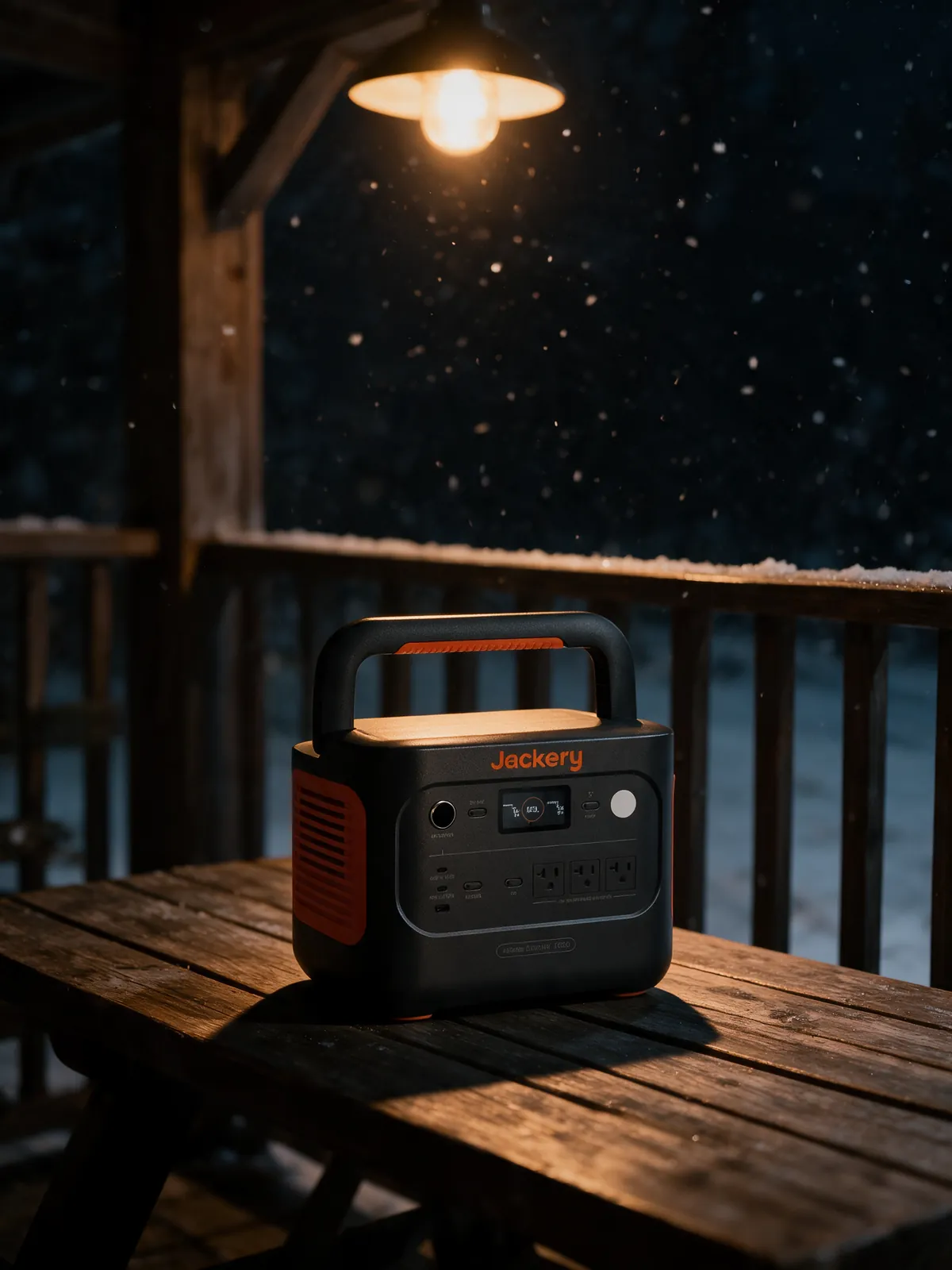
Jackery Explorer 1000 v2 Portable Power Station
$449-799
1070Wh LiFePO4 portable power station with 1500W AC output.
Affiliate linkDo portable power stations work in cold weather? Yes — but output drops and there's one safety rule that does permanent damage if you break it. The honest physics of lithium below freezing, why LiFePO4 survives the cold, and the three units built to handle it.
Yes — portable power stations work in cold weather, but with two honest catches. First, usable output drops in the cold; below freezing a lithium unit can deliver noticeably less than its rated watt-hours, so a 1,000Wh station may behave like ~600–700Wh on a hard winter night. Second, and more important: you must never charge a cold lithium battery below 32°F — doing so plates lithium onto the cells and permanently damages them. LiFePO4 chemistry holds up far better in cold than older packs, and a unit with low-temperature charge protection is the one to buy for winter.
Disclosure · As an Amazon Associate, BlackBox Supplies earns from qualifying purchases — at no extra cost to you. See our full disclosure.
Yes, portable power stations work in cold weather — winter campers, ice-fishing setups, and cold-climate preppers use them every season. But 'works' is doing some quiet lifting in that sentence, and the two things it glosses over are exactly what you need to understand before you spend money on one.
The first is output. A lithium battery is a chemical reaction, and chemical reactions slow down when they get cold. As the cells chill toward and below freezing, their internal resistance climbs, voltage sags under load, and the pack simply can't hand over as much of its stored energy. Nothing is broken — warm the unit back up and the capacity comes back — but on the cold night you actually needed it, you get less than the sticker promises. Plan around that, not around the number on the box.
The second is a safety rule, and it's the one that can turn an expensive power station into a paperweight. It has nothing to do with using the unit and everything to do with charging it. We'll get to it — it's the most important paragraph on this page.
This is the H2 people search for, so here's the straight version. Discharge — running your devices — still works in the cold. What changes is how much of the rated capacity you can pull out before the unit cuts off.
The magnitude depends on the chemistry, the temperature, and how hard you're pulling. As a general rule for lithium packs, capacity starts to taper once cells drop below roughly 32°F (0°C) and the loss deepens the colder it gets; by the time cells are well below freezing, a meaningful chunk of usable energy is temporarily unavailable. A common planning figure people use is that a hard-freeze night can cost you on the order of a third of usable capacity versus a room-temperature run — which is why a nominally 1,000Wh unit can behave like it holds ~600–700Wh when it's genuinely cold. Treat that as a planning cushion, not a precise measurement: the exact figure varies by unit and conditions, and we don't bench-test these in a freezer.
The practical takeaway is simple. If your winter load is 'a fridge overnight' or 'a CPAP till morning,' don't buy the unit whose rated capacity exactly matches your math — buy one with headroom, because the cold eats the margin. And keep the unit itself warm (more on that below), because a warm battery in a cold tent loses far less than a frozen one.
| Condition | What happens to output | What to do about it |
|---|---|---|
| Room temp (~70°F) | Full rated usable capacity | Nothing — this is the baseline the box is rated at |
| Cool (40–50°F) | Slight drop; barely noticeable | Run it normally |
| Near freezing (32–40°F) | Capacity starts to taper; voltage sags under heavy load | Insulate the unit; start fully charged |
| Below freezing (under 32°F) | Meaningful temporary capacity loss; heavy loads may trip low-voltage cutoff early | Keep it in the tent/cab, size up, and NEVER charge it cold (see below) |
| Deep cold, well below freezing | Largest loss; a cold pack may refuse to charge at all (a protection feature, not a fault) | Warm the unit before charging; rely on self-heating if the unit has it |
This is the paragraph to remember. Discharging a lithium battery in the cold is fine — it just gives you less. Charging one below 32°F (0°C) is not fine, and the damage is permanent.
When you push charge current into a lithium cell that's below freezing, the lithium ions can't intercalate into the anode fast enough, so metallic lithium plates onto the anode surface instead. That plated lithium doesn't come back. It permanently reduces capacity, and over repeated cold charges it can grow dendrites that eventually cause an internal short — the genuinely dangerous failure mode. This is true of both LiFePO4 and the NMC/lithium-ion cells in phones and older power banks; it is fundamental battery chemistry, not a brand quirk.
That is why 'low-temperature charge protection' matters more than any headline spec for winter use. A well-designed power station's battery management system (BMS) will simply refuse to accept a charge when its cells are too cold — which feels like a malfunction ('why won't it charge?!') but is actually the unit protecting itself from the damage above. Better still are units with self-heating, which warm the cells before allowing a charge. When you shop for a winter unit, this is the feature to confirm on the live listing: does the BMS block sub-freezing charging, and does it self-heat? Solar-charging in winter makes this especially relevant, since a panel can try to feed a frozen pack at dawn.
Portable power stations come in two broad battery chemistries: LiFePO4 (lithium iron phosphate, sometimes 'LFP') and NMC (nickel-manganese-cobalt), the same family as most phones and older power banks. For cold-weather use, LiFePO4 is the clear pick, and all three units below use it.
LiFePO4's advantage isn't that it ignores the sub-freezing charge rule — no lithium chemistry does. It's that LiFePO4 is more thermally stable, far more resistant to the runaway failure that makes damaged NMC cells dangerous, and rated for many more charge cycles, so a winter unit lasts through years of seasonal use instead of aging out. EcoFlow, for example, rates the RIVER 2 Pro's LiFePO4 cells for 3,000+ cycles. That longevity is the reason the whole industry moved to LiFePO4 for anything meant to sit in a cabin, an RV, or a truck bed and get used hard.
The honest tradeoff: LiFePO4 units are a bit heavier and slightly bulkier per watt-hour than the NMC packs they replaced. For a winter camper or a home-backup buyer, that weight is a fine price for cold stability, safety, and cycle life. If you specifically need the lightest possible pack for airline travel, that's a different article (and a different, sub-100Wh product) — a winter power station is not a carry-on.
All three are LiFePO4 — the chemistry that survives winter — and all three route to our product pages, where the full spec sheet and the Amazon handoff live. They're the top LiFePO4 units from our power-stations comparison guide (/guides/best-power-stations-compared), which lays out the LiFePO4-vs-NMC chemistry difference in full. We don't print prices here because they change daily: check the live price on Amazon from each product page. Specs below are the manufacturers' own figures as listed in our catalog. We research from published specs and owner reviews; we don't run a freezer lab, so where cold behavior matters to your exact use, confirm the low-temp charging details on the live listing.
Pick by how much you need to run overnight. The EcoFlow RIVER 2 Pro (768Wh) is the light, packable choice for a CPAP or a small load. The Jackery Explorer 1000 v2 (1,070Wh) is the do-everything overnight unit. The Bluetti AC180 (1,152Wh) is the most capacity and the stoutest inverter, for the buyer who wants headroom and UPS backup and doesn't mind the weight.
$449-799
1070Wh LiFePO4 portable power station with 1500W AC output.
Affiliate link
$399-699
1152Wh LiFePO4 portable power station with an 1800W inverter and UPS backup.
Affiliate link
$369-399
768Wh LiFePO4 portable power station with a fast ~70-minute recharge.
Affiliate link| Unit | Capacity | AC output | Recharge | Weight |
|---|---|---|---|---|
| Jackery Explorer 1000 v2Check price on Amazon → | 1,070Wh LiFePO4 | 1500W (3000W surge) | ~1 hr | ~23.8 lb |
| Bluetti AC180Check price on Amazon → | 1,152Wh LiFePO4 | 1800W (2700W peak) | 0–80% in ~45 min | ~35 lb |
| EcoFlow RIVER 2 ProCheck price on Amazon → | 768Wh LiFePO4 | 800W (1600W X-Boost) | 0–100% in ~70 min | ~17 lb |
This page is written by the BlackBox gear desk. We compared the manufacturers' published specs — chemistry, rated capacity, output, and recharge times — against the well-established physics of how lithium cells behave in the cold, and against patterns in long-term owner reviews. We have not personally cold-chamber-tested these units and we don't claim a number we didn't measure; the capacity-loss figures here are general planning ranges, stated as such, not a bench result for a specific unit. Prices are approximate and drift with sales. Where the exact low-temperature charging behavior matters for your trip, confirm it on the current product listing before you buy. As an Amazon Associate we earn from qualifying purchases; that never changes which chemistry survives the cold.
Yes — they run your devices fine in the cold, but usable output drops as the battery chills. Below freezing a lithium unit can temporarily deliver noticeably less than its rated watt-hours, so a 1,000Wh station may behave like ~600–700Wh on a hard winter night. Keep the unit warm and start fully charged, and it works well; just size up so the cold-weather capacity loss doesn't leave you short.
No — this is the rule that does permanent damage. Charging a lithium battery below 32°F (0°C) plates metallic lithium onto the cells, causing permanent capacity loss and a long-term safety risk. Discharging cold is safe; charging cold is not. Buy a unit with low-temperature charge protection (its BMS refuses a cold charge) or self-heating, and always warm the unit to room temperature before charging it after it's been out in the cold.
For a power station, yes. LiFePO4 (LFP) is more thermally stable, far more resistant to dangerous thermal runaway, and rated for many more charge cycles than the NMC lithium-ion in older packs — so it survives seasons of cold use. It does not escape the sub-freezing charge rule (no lithium chemistry does), but it's the chemistry to buy for winter. All three units we recommend here are LiFePO4.
It varies by unit, temperature, and load, so treat any single figure as a planning cushion rather than a spec. As a general rule, capacity starts tapering below about 32°F and the loss deepens the colder it gets; a common planning assumption is that a hard-freeze night can cost roughly a third of usable capacity versus a room-temperature run. The loss is temporary — warm the unit and the capacity returns — which is why keeping it insulated in the tent or cab matters so much.
Store and run it inside the tent or vehicle cab rather than on frozen ground, insulate it with a blanket or a soft cooler bag, and start the trip fully charged so you never have to charge it cold in the field. Under load the unit's own waste heat helps keep it above freezing when it's wrapped. If it does get cold-soaked, warm it before charging.
Pick by overnight load, and pick LiFePO4. The EcoFlow RIVER 2 Pro (768Wh) is the light, packable choice for a CPAP or small load; the Jackery Explorer 1000 v2 (1,070Wh) is the do-everything overnight unit; and the Bluetti AC180 (1,152Wh, 1800W) gives the most capacity and headroom plus UPS backup for cold-climate blackouts. Size up a tier from your room-temperature math to cover the cold-weather capacity loss.
Research-driven: our picks come from verified manufacturer specs and long-term owner feedback. How we work: our methodology.
The car, power, cooling, and work-utility gear worth owning — with the honest catch on each. One genuinely useful email a week. No spam, no fake reviews, unsubscribe anytime.