The room won't cool and there's no central air — here's exactly what to do
It's the hottest room in the house, there's no vent feeding it cool air, and a single fan is just pushing warm air around. Before you buy anything, four free moves will take the edge off in minutes — and they're the same steps that tell you whether you need a real cooling unit or just better airflow. Here's the honest triage, in order.
By Lee · Researched & cited · Updated Oct 2026
Before you buy anything
- 1
Stop the heat coming in
Sun through glass is usually the single biggest reason one room bakes. Close curtains or blinds on any window the sun hits, and use blackout or light-colored coverings if you have them. Do this before the room heats up in the morning, not after — you can't easily undo solar gain once it's soaked into the walls and floor.
- 2
Flush the hot air once it's cooler outside
After sunset, once outdoor air actually drops below your indoor temperature, put a box or window fan in the window facing OUT to push the trapped hot air out. Crack a window on the opposite side of the room so cooler air gets pulled in across it. Close everything back up before the day heats again to trap the cool you gained overnight. If it's still hotter outside than in, skip this step — you'll only pull more heat in.
- 3
Kill the heat sources inside the room
Incandescent bulbs, a gaming PC or console, phone chargers, and especially any oven or stovetop all dump real heat into a small space. Swap to LED bulbs, unplug electronics you're not using, and avoid cooking hot meals in or near the room during the day. In a closed room these add up faster than people expect.
- 4
Cool the person, not the room
Moving air evaporating sweat off your skin is what actually cools you, so point a fan directly at yourself rather than at the ceiling. Stay hydrated and lay a cool damp cloth on your neck or wrists. A bowl of ice set in front of a fan gives a modest, short-lived boost — helpful, but don't expect it to cool the whole room. Never run anything that burns fuel — a grill, camp stove, or generator — indoors to cope with heat; that's a carbon-monoxide risk, not a cooling method.
The one thing that solves it today
If the room genuinely won't drop — it's enclosed, humid, or the airflow tricks aren't enough — a portable AC is the only thing on this list that actually removes heat and pulls moisture out of the air, rather than just moving it around. It vents warm air out through a window kit you set up in minutes, so you can cool the one room that matters without central air. Size it to the room: a 14,000 BTU unit for a bedroom or living space, a smaller 10,000 BTU for a compact room or office.
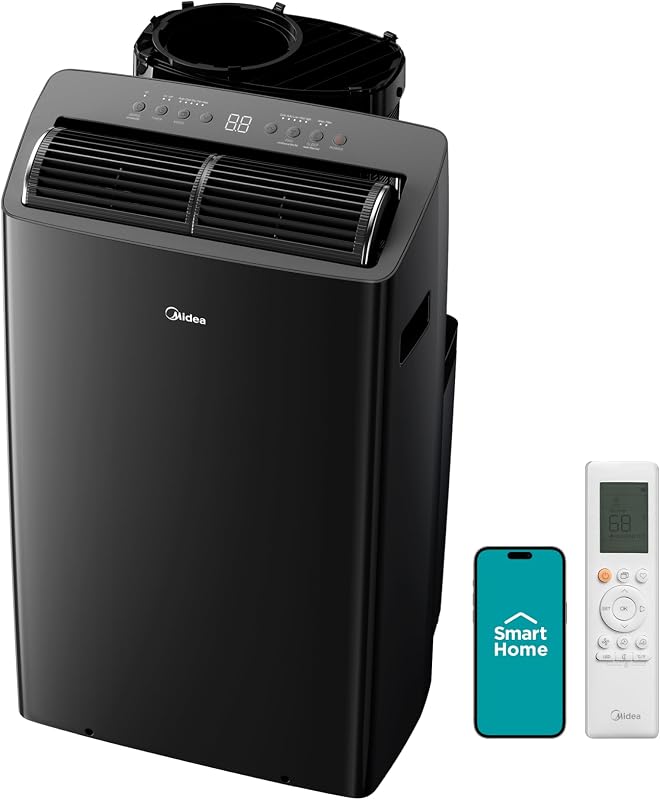
Midea Duo 14,000 BTU Smart Inverter Portable Air Conditioner (MAP14S1TBL)
One of the quietest, most efficient portable ACs you can buy: the inverter compressor holds a steady temperature at around 42 dB instead of cycling loudly, and it both cools and heats, so it earns its place year-round.

BLACK+DECKER 10,000 BTU 3-in-1 Portable Air Conditioner (BPACT10WT)
A no-frills, budget-friendly 3-in-1 that cools, dehumidifies, and runs as a fan, with a 'Follow Me' remote that reads the temperature where you are. A dependable pick for a medium room without paying for smart features.
Never get caught here twice
To stop a room reaching crisis heat in the first place, own a strong circulating fan and keep air moving before the worst of the day — steady airflow makes a hot room livable and lets a portable unit work far less. A quiet oscillating tower fan is the everyday workhorse for a bedroom or living room, while a misting fan adds evaporative cooling that helps most in dry air and outdoors, on a patio or in a garage.

Dreo Cruiser Pro T1 Oscillating Tower Fan
A quiet, well-priced oscillating tower with a genuinely wide speed range and useful modes, pushing air about 26 ft. A strong value pick for everyday room cooling.

Shark FlexBreeze Pro Mist Fan (FA302, Indoor/Outdoor Misting)
A genuinely versatile indoor/outdoor fan that runs corded or cordless and adds a fine mist - fill the tank with ice and it can feel up to 12 degrees cooler. Ideal for patios and yards where you want cooling without a power outlet nearby.
Questions people ask
Will a portable AC or a swamp cooler cool my room better?
It depends on your humidity. A portable AC uses refrigerant to remove both heat and moisture, so it works anywhere — including humid climates and closed rooms — and typically drops the temperature more. An evaporative (swamp) cooler adds moisture and only cools well in dry air, generally below about 50% humidity, and it needs a window or door cracked for fresh air. If you're in a humid area or a sealed room, go with a portable AC.
Does a portable AC really need a window?
Yes. A portable AC removes heat from the room and has to send that hot air somewhere, so it vents through a hose and a window kit that seals the opening. Without venting it would just move heat around the room and warm it up over time. If you truly have no window, an evaporative cooler or a battery-powered unit designed to run without ducting is the more realistic option — but expect noticeably less cooling.
Why isn't my fan cooling the room down?
A fan doesn't lower the actual air temperature — it cools you by evaporating sweat off your skin. That's why a fan feels great when it's pointed at you but does almost nothing for an empty room. To make a fan lower the room temperature, use it to exchange air with cooler outdoor air at night, or aim it directly at people. If you need the air itself to be colder, you need an AC.
What size portable AC do I need for one room?
A rough starting rule is about 20 BTU per square foot, but portable ACs lose some real-world capacity to their own exhaust and startup, so size conservatively. In practice a 10,000 BTU unit suits a small room or office up to roughly 300–450 sq ft, while a 14,000 BTU unit handles a bedroom or living space up to roughly 500–650 sq ft. Sun-facing rooms, top floors, and kitchens run hotter, so size up if that's your room. Ratings also vary by how they're measured (older ASHRAE numbers run higher than newer SACC ones), so check the specific unit's stated coverage before you buy — we don't test these in-house, so the manufacturer's room rating is your best reference.