
Portable AC
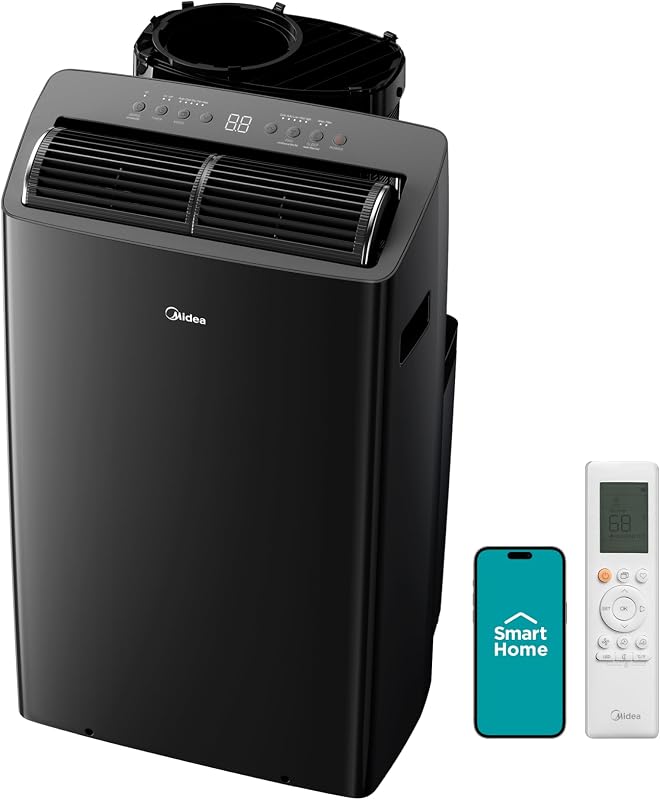
Midea Duo 14,000 BTU Smart Inverter Portable Air Conditioner (MAP14S1TBL)
$500-$650
One of the quietest, most efficient portable ACs you can buy.
Affiliate linkTwo completely different machines are sold under the same three words, and the listing almost never tells you which one you're getting. One is a genuine heat pump worth paying for. The other is a $40 space heater in a $600 chassis. Here is the number that separates them.
Usually yes — but only if the heat is reverse-cycle rather than a resistive element, and only if the same room is both too hot in July and too cold in October. Check the heating BTU: above roughly 5,100 on a standard plug it is almost certainly moving heat rather than making it, and above about 6,140 it cannot be doing anything else. Below that, buy a space heater.
Disclosure · As an Amazon Associate, BlackBox Supplies earns from qualifying purchases — at no extra cost to you. See our full disclosure.
"With heat" is the least informative phrase in the portable air conditioner category. It appears on units whose heating hardware has nothing in common except that it is bolted into the same rolling box, and the difference between them is not a matter of degree — it sets your running cost, permanently, for as long as you own the thing.
The first kind is resistive. Somewhere inside is a coil of wire; electricity passes through it and the wire gets hot; a fan blows air across it. This is exactly, precisely the physics of the $40 space heater at the hardware store — not similar to it, identical to it. Resistive heating converts electrical energy to heat at a ratio of one to one and it cannot do better, ever, because there is no better. Every watt you buy becomes one watt of heat. That is the ceiling and the floor.
The second kind is reverse-cycle, and to understand it you have to notice something about the air conditioner you already own: it does not make cold. There is no such thing as cold to make. An air conditioner is a heat pump — a machine that picks heat up in one place and puts it down in another, which is why it needs a hose to the outdoors and why the back of it blows hot. Cooling your room is a side effect of moving your room's heat outside.
A reversing valve is a component that swaps which coil is doing which job. Flip it and the same compressor, the same refrigerant, the same two coils now collect heat from the outdoor air and release it into your room. The machine runs backwards, and it is still a pump rather than a generator. That distinction is the whole ballgame, because a pump is not bound by the one-to-one rule. It does not create the heat it delivers; it fetches it. The electricity is only paying for the fetching.
So a reverse-cycle unit delivers more heat energy than the electrical energy it consumes. That ratio is called the coefficient of performance, or COP, and a COP of 1.0 is what resistive heating scores by definition — that much is not an estimate, it is what the words mean. How far above 1.0 any particular machine lands is the part we cannot tell you, and we are not going to invent it: neither EcoFlow nor Midea publishes a COP for the units in our catalog, and we have no independent rating of either to point you at. What is certain is the direction, and that it compounds. If a unit ran at a COP of 2.5, the same warmth would cost roughly 40% of what the resistive version costs. Over one cold weekend a gap like that is invisible. Over eight weeks of daily shoulder-season use it is the reason the feature exists.
Here is the problem the rest of this page exists to solve: almost nothing in a product listing tells you which one you are buying. The efficiency figure that would settle it is not published. The word "heat" is used identically for both technologies. You have to work it out from a number that manufacturers cannot fudge — and fortunately there is one.
| Resistive element | Reverse-cycle (heat pump) | |
|---|---|---|
| What it is | A coil of wire that gets hot | The AC running backwards through a reversing valve |
| Heat per watt of electricity | Exactly 1.0 — the physical ceiling | Above 1.0. Neither maker publishes the figure |
| Running cost for the same warmth | Highest possible | Lower, by an amount nobody has published |
| Output on a standard US outlet | ~5,100 BTU/h in practice; 6,140 is the circuit's limit | Can exceed both — the heat is fetched, not made |
| Affected by outdoor temperature | No — a wire is a wire | Yes — output falls as it gets colder outside |
| Worth paying a premium for | No. A space heater does the identical job | Yes, if you will actually run it for weeks |
Watts and BTUs measure the same thing in different units, and the conversion is fixed: one watt equals 3.412 BTU per hour. That single fact turns a marketing spec into a diagnosis.
A standard US household circuit is 15 amps at 120 volts, which is 1,800 watts — the absolute most anything plugged into it can draw. Heaters are built to sit under that with margin, because an appliance that runs for hours is not supposed to park at a circuit's limit, which is why essentially every plug-in space heater sold in America is a 1,500-watt device. Convert both numbers: 1,500 watts times 3.412 is about 5,118 BTU per hour, and the circuit's own 1,800-watt maximum is about 6,140.
Those two figures bracket the whole question, and it is worth being exact about which is which. About 5,100 BTU/h is the market ceiling: it is what the 1,500-watt element in a normal plug-in heater produces, and almost nothing on a shelf exceeds it. About 6,140 BTU/h is the physical one: no resistive element on a 15-amp, 120-volt outlet can beat that at any rating, because it would have to draw more electricity than the circuit can supply. Which gives you the test:
If a portable AC advertises heating output comfortably above 5,100 BTU/h and plugs into a normal outlet, the heat is almost certainly not coming from a wire; above about 6,140 it cannot be. It is being pumped. If the heating figure sits at or below roughly 5,100 — and especially if it lands suspiciously near a round 5,000 — assume resistive until the manufacturer says otherwise in writing.
There is a second tell, and it is the one that separates people who understand this category from people who are guessing. Look at whether the heating BTU is higher or lower than the cooling BTU on the same unit. On a genuine reverse-cycle machine, heating capacity is normally the larger of the two — because in heating mode the room receives both the heat harvested from outside and the waste heat of the compressor doing the harvesting, while in cooling mode that compressor heat gets thrown out of the window along with everything else. A unit rated to heat more than it cools is showing you its mechanism.
Apply both tests to the EcoFlow WAVE 3 — on paper, against the published figures, which is the only way anyone reading a listing can apply them — and they agree. EcoFlow's product page states "6100 BTU cooling" and "6800 BTU heating". The heating number clears both ceilings: 6,800 BTU/h works out to about 1,993 watts of delivered heat, more than a 15-amp circuit can supply at all, and the Amazon listing we link states the same figure in watts, as "2000W/6800 BTU Heating". It is also higher than the cooling number. Both tells point the same way.
Two honest boundaries on that conclusion. First, EcoFlow's product page publishes the BTU figures and calls the feature "It's Also a Heater", but on that page it does not name the heating mechanism, and the phrase "heat pump" does not appear there at all. Second, the outlet ceiling is the weaker half of the argument for this particular machine, because the WAVE 3 can run from its own battery rather than a wall circuit, so "more than a 15-amp outlet can supply" constrains it less than it would a mains-only unit. The heating-exceeds-cooling tell does not depend on the outlet at all, and it points the same way. So treat reverse-cycle as strongly indicated by the numbers rather than as a specification we can quote back to you. We are showing you the reasoning precisely so you can check it rather than take our word for it.
| What the listing says | What it probably means | What to do |
|---|---|---|
| Heating output near or below ~5,100 BTU/h | Resistive element — a space heater inside the AC | Do not pay a premium for it |
| Heating output well above ~5,100 BTU/h | Almost certainly reverse-cycle; certain above ~6,140 | This is the version worth money |
| Heating BTU higher than cooling BTU | Reverse-cycle signature | Good sign; confirm the model number |
| Only a wattage, no heating BTU | Multiply watts by 3.412 yourself | Then apply the rules above |
| "With heat" and no number at all | Unknowable from the listing | Open the manufacturer's spec page or skip it |
This is the part of the research that changed what this page says, and it is the single most useful thing we can tell anyone shopping this query.
Midea's US site currently lists two Duo portable air conditioners that are, on paper, the same machine. Both are 12,000 BTU DOE. Both are rated for spaces up to 550 sq ft. Both advertise ultra-quiet operation as low as 42 dB. Both use the hose-in-hose dual-hose design. Midea publishes the same dimensions for both, to the hundredth of an inch — 32.48 inches tall by 19.53 wide by 16.73 deep. And only one of them heats.
The one that does is model MPT1412HVRU, which Midea titles "Midea 12,000 BTU DOE DUO Smart Inverter Portable Air Conditioner with Heat Pump, for spaces up to 550 sq. ft." and describes as offering "4-in-1 Comfort: Cooling, Heating, Dehumidifying & Fan Modes". That is where the phrase "heat pump" comes from — it is Midea's own word, printed in Midea's own product title, and it applies to that model number and no other.
The other is model MAP14S1TBL-A, which Midea titles simply "Midea 12,000 BTU DOE DUO Smart Inverter Portable Air Conditioner" — no heat in the name. Its published specification table includes a dedicated row that reads "Heat: No".
We will be straight with you about a complication, because glossing it would be the dishonest move. That same MAP14S1TBL-A specification table also contains a row reading "Comfort Features: Cool, Dehumidify, Ventilate, Heat". Midea's page contradicts itself: one row lists Heat among the comfort features, another row says Heat: No. We cannot resolve that from outside the company, and we are not going to pick the reading that suits us. What we can say is that Midea markets a separate SKU whose entire distinguishing feature is heating, which strongly suggests the plain-named model is the cooling-only one and the "Comfort Features" string is boilerplate shared across the Duo family.
Meanwhile, the Amazon listing we link for the Duo — ASIN B0FC2SGGF9 — is titled "Midea Duo 14,000 BTU Portable Air Conditioner with Heat, Inverter Quiet | 12,000 BTU SACC High Efficiency Inverter Portable AC, with Heat up to 550 Sq.Ft. Smart/Remote Control, Alexa/Google Assistant". The words "with Heat" appear in it twice. Our own catalog records that product's model number as MAP14S1TBL — the number Midea spec-sheets as Heat: No.
So here is our position, stated plainly. We are not going to tell you the Midea Duo behind that link is a heat pump, because we could not confirm it on Midea's own product page for that model number, and confirming it there was the standard we set ourselves before writing. What we will tell you is the actionable version: if you are buying a Midea Duo specifically because it heats, read the model number in the listing's own specification block before you order, and look for MPT1412HVRU or a title that names the heat pump. Two units that share a product family, a BTU rating, a room rating, a noise rating and a silhouette are exactly the conditions under which people receive the wrong box.
That advice generalises past Midea. Manufacturers routinely ship cool-only and cool-and-heat variants of the same chassis under model numbers that differ by two characters, and marketplace listings frequently merge, mislabel or inherit the wrong variant's copy. In this category the model number is not a detail. It is the spec.
| MAP14S1TBL-A | MPT1412HVRU | |
|---|---|---|
| Midea's product title | "...DUO Smart Inverter Portable Air Conditioner" | "...Portable Air Conditioner with Heat Pump" |
| Cooling | 12,000 BTU DOE | 12,000 BTU DOE |
| Room size | Up to 550 sq ft | Up to 550 sq ft |
| Quoted noise floor | As low as 42 dB | 42 dB |
| Heating | Spec table row reads "Heat: No" | "4-in-1 Comfort: Cooling, Heating, Dehumidifying & Fan Modes" |
| Listed weight | 73.85 lbs | 77.16 lbs |
$500-$650
One of the quietest, most efficient portable ACs you can buy.
Affiliate linkThe WAVE 3 is the cleaner example, because EcoFlow publishes the heating spec next to the cooling spec on the same page and the numbers behave the way reverse-cycle numbers behave. It is also the more expensive answer by a wide margin, and it is the wrong answer for most rooms, so the honest treatment is to show you both halves.
EcoFlow's page states 6,100 BTU cooling and 6,800 BTU heating, and quotes speed claims for each: a 15°F drop in 15 minutes, and a 17°F rise in 15 minutes. It lists a Sleep Mode that "operates at just 44 dB, about the same as a quiet conversation", an insulated exhaust duct rather than a permanent window installation, app control through EcoFlow's Oasis platform, and an add-on 1,024Wh LFP battery good for "up to 8 hours" of cordless running.
Now read the disclaimers, because EcoFlow prints them and almost nobody quotes them. Both temperature-change claims are footnoted "Tested in a 10 cubic meter space" — at 77°F for the cooling figure and 60°F for the heating one.
Ten cubic metres is about 353 cubic feet. That is a space roughly seven feet by seven feet with a seven-foot ceiling. It is a tent. A modest 12 ft by 12 ft bedroom with 8 ft ceilings is 1,152 cubic feet — more than three times the volume — and a 550 sq ft living space of the sort the Midea is rated for is over twelve times it. None of this makes EcoFlow's claim untrue; a stated test condition honestly disclosed is exactly what a spec footnote is for. It does mean that the headline "17°F in 15 minutes" describes a tent warming up, and you should not carry that number into a bedroom.
The second footnote is worth the same attention. The 8-hour battery figure is qualified as "8 hours of wireless use in Eco Mode under optimal conditions". Check what that implies with arithmetic you can do yourself: 1,024Wh spread across 8 hours is an average draw of about 128 watts. Full-tilt heating at 6,800 BTU/h means delivering roughly 1,993 watts of heat, which even at a generous COP of 2.5 would draw close to 800 watts and flatten that battery in something like 75 minutes. The 8-hour number and the 6,800 BTU number are not describing the same hour of operation, and no reasonable reading of EcoFlow's page says they are. If you are planning around cordless heat, plan around roughly an hour of hard output or a night of gentle output — not eight hours of the headline figure.
What the WAVE 3 genuinely buys you is the thing no conventional unit can do at all: it heats and cools a space with no permanent window installation and no wall outlet. For a van, a tent, a boat cabin, a semi sleeper or an outbuilding with no power, that capability has no substitute at any price, and the fact that it also heats is what makes it a four-season purchase instead of a summer one. Our catalog's honest counterweights stand: at 6,100 BTU it only cools a small space, not a full-size room; the battery is a separate add-on that raises the total cost significantly; it is a premium price against conventional portable ACs; and cordless runtime drops when running at full power. If you have a window and a wall socket, you are paying a large premium for a capability you will never use.

$899-$1,499
It cools and heats, but at 6,100 BTU it's built for small spaces, not a living room.
Affiliate linkIt is worth saying clearly, because every other page on this query is trying to sell you the upgrade: for a large share of people asking this question, the answer is no, and the reasons are specific rather than vague.
It is worth it when three things are true at once: the heat is reverse-cycle rather than a resistive element, the same room is genuinely both too hot in summer and too cold in the shoulder seasons, and that room is not already well served by your central heating. Meet all three and one appliance covers twelve months instead of four, which is good value. Miss any one of them and you are paying a premium for a feature that will run twice and then be forgotten while the window panel stays in all winter.
Use the BTU number. One watt is 3.412 BTU per hour. Essentially every plug-in space heater sold in the US is a 1,500-watt device, which is roughly 5,118 BTU/h, and a 15-amp, 120-volt circuit caps anything plugged into it at 1,800 watts, or about 6,140 BTU/h. So if a unit on a normal plug advertises heating output comfortably above about 5,100 BTU/h, the heat is almost certainly being pumped rather than generated, and above about 6,140 a wire on that circuit physically cannot produce it. A second tell: on a genuine reverse-cycle unit the heating BTU is usually higher than the cooling BTU, because in heating mode the room receives the compressor's waste heat as well as the heat harvested from outside.
EcoFlow's product page states 6,100 BTU cooling and 6,800 BTU heating and calls the feature "It's Also a Heater", but it does not name the heating mechanism on that page and the phrase "heat pump" does not appear there. What we can say is that both diagnostic signs point one way: 6,800 BTU/h is about 1,993 watts of delivered heat, more than a 15-amp household circuit can supply at all, and the heating figure exceeds the cooling figure, which is the reverse-cycle signature. Be aware the first of those is weaker than it looks for this unit specifically, because the WAVE 3 can run from its own battery rather than a wall circuit; the second does not depend on it. We are showing you the reasoning rather than asserting a spec EcoFlow has not published.
It depends entirely on which Duo, and this catches people out. Midea's site lists two Duo portables at 12,000 BTU DOE and 550 sq ft with the same 42 dB claim. MPT1412HVRU is titled by Midea as being "with Heat Pump" and lists cooling, heating, dehumidifying and fan modes. MAP14S1TBL-A is titled without any mention of heat and its specification table carries a row reading "Heat: No" — although, confusingly, the same table also lists Heat among its comfort features. If you are buying a Duo for the heating, read the model number in the listing's own specification block before ordering rather than trusting the product title.
There is no single answer, and the honest position is that neither EcoFlow nor Midea publishes a minimum operating temperature for heat mode on the product pages we checked. What is certain is the direction: a heat pump's output falls as outdoor temperature falls, because there is less heat in the air to collect and a bigger temperature lift to deliver it across. Small units lose meaningful capacity well before freezing, and below some threshold they either fall back to resistive heating or stop. Treat any portable heat mode as a shoulder-season and mild-winter tool, not as primary heating in a genuinely cold climate.
Almost certainly a defrost cycle, and it is normal. When the coil that harvests heat from outdoor air drops below freezing while humid air passes over it, frost builds up and blocks the airflow the machine needs. Every heat pump handles this by pausing the heating and briefly running to melt the ice off, which is why you get a few minutes of cool air. It happens more often in damp, near-freezing conditions than in dry cold. Persistent cold air with no recovery is a different matter and worth raising with the manufacturer.
Research-driven: our picks come from verified manufacturer specs and long-term owner feedback. How we work: our methodology.
The car, power, cooling, and work-utility gear worth owning — with the honest catch on each. One genuinely useful email a week. No spam, no fake reviews, unsubscribe anytime.