A fender-bender and it's your word against theirs — here's exactly what to do
The bumpers touched, everyone's fine — and then the other driver starts telling a version of events that isn't what happened. In a low-speed collision there's rarely a clean skid mark or a totaled car to prove who did what, so the claim often comes down to whose story the insurer believes. The good news: in the next fifteen minutes you can build a record that speaks for you, no matter what the other person says.
By Lee · Researched & cited · Updated Oct 2026
Before you buy anything
- 1
Get safe, then stay put
Check everyone in both vehicles first — if anyone is hurt, dazed, or unsure, call 911 immediately, because injuries change everything about how this is handled and getting help fast matters more than any photo. If the cars are drivable and blocking traffic, pull them onto the shoulder and switch on your hazards; if they're not drivable, leave them where they are and get yourself off the roadway. Never leave the scene of a collision, even a tiny one — that can turn a fender-bender into a hit-and-run charge.
- 2
Photograph everything before anything moves
Shoot wide first — the whole scene, both cars in position, lane markings, traffic signals and any nearby signs — then close-ups of every point of contact on both vehicles. Capture both license plates and the other car's insurance card if they'll show it. Most phones embed time, date and, if location is on, GPS coordinates into each photo's metadata, and those details are exactly what an adjuster uses to reconstruct who was where — so turn location on if it isn't, and take far more shots than you think you need.
- 3
Exchange info without admitting fault
Trade names, phone numbers, insurance company and policy numbers, plus the other driver's plate and license. Stick to facts — do not say "sorry" or "my fault," because a casual apology can be read as an admission and used to shift blame onto you. Keep it brief and civil; you're gathering information, not negotiating the claim on the shoulder.
- 4
Lock in witnesses and a police report
Anyone who saw it is your strongest neutral proof — get their name and number fast, before they drive off, and if they're willing, record a few seconds of what they saw on your phone. If police didn't come to the scene, call the non-emergency line and ask how to file an official report; that independent record, with the officer's diagram and notes, often outweighs two drivers contradicting each other. Then notify your own insurer promptly with everything you gathered, even if you think the other side will pay.
The one thing that solves it today
The one thing that ends "your word against theirs" for good is footage. A front-and-rear dash cam records the moments before, during and after impact from both directions — and since rear-end hits are the most common collision, the rear channel matters as much as the front. If you're shopping today, a dual-channel cam with a genuine sensor on both ends and buffered parking mode gives you objective proof the next time someone rewrites the story.
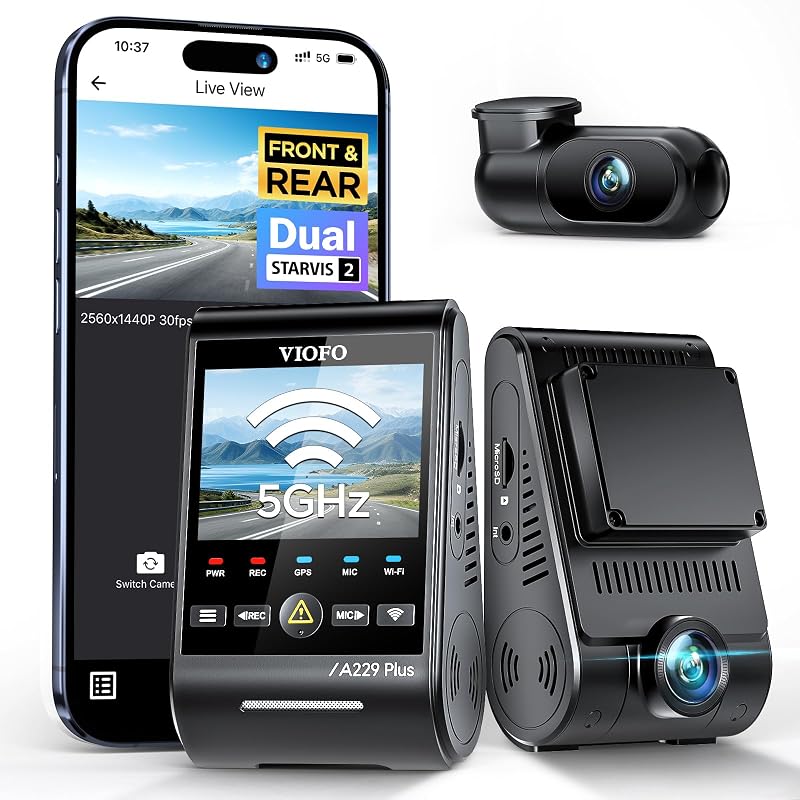
VIOFO A229 Plus (2CH Front + Rear)
The reference-grade front+rear crash-protection setup reviewers keep crowning best-overall — twin STARVIS 2 sensors keep plates legible day and night, exactly the footage that wins an insurance dispute.

REDTIGER F7N (4K Front + Rear)
A value front+rear dash cam people compare against Rove and Viofo. A memory card in the box plus a bright, easy-to-read screen make it a simple pick for affordable two-way coverage.
Never get caught here twice
Own the camera before you ever need it, and the dispute never happens — the footage simply exists. For fuller coverage, a three-channel setup adds an interior or cabin view alongside front and rear, and a smart cam with a hardwired parking mode keeps watching while you're away, so a hit-and-run in a parking lot is captured too — not just collisions you're awake for. Buy a card rated for the job (128GB or more) and let it run every drive; the whole point is that it's already recording when the unexpected happens.
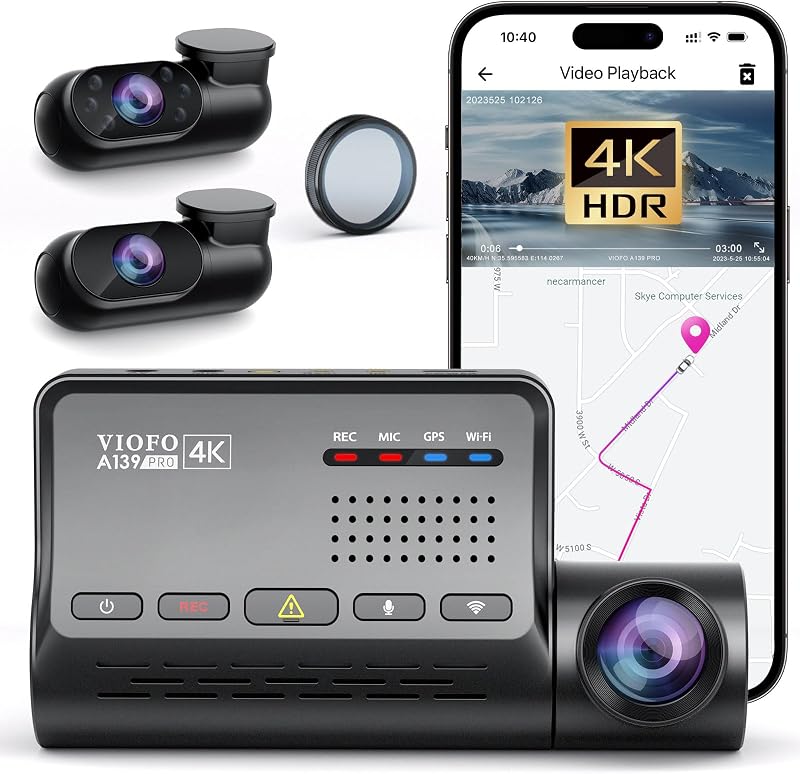
VIOFO A139 Pro (3CH Front + Interior + Rear)
The premium rideshare/fleet answer — true 4K forward detail plus an IR interior channel that documents the cabin. Strong total-coverage angle for professional drivers.

Nextbase iQ 4K Smart Dash Cam (Front + Rear)
The aspirational halo of the lineup — a smart guardian that streams live and can call for help on impact. The connected/SOS angle sells protection well beyond plain loop footage.
Questions people ask
Is dash cam footage actually accepted as evidence for an insurance claim?
Yes — insurers routinely accept dash cam video, and clear footage of who crossed a line or struck whom often resolves a disputed claim quickly. It carries weight precisely because it's an objective timestamped record rather than one driver's recollection. Save the clip immediately and don't let the camera overwrite it: pull the file off the card, or at minimum lock it so the loop recording can't erase it.
Do I really need a rear camera, or is a front-only dash cam enough?
A front-only cam misses the single most common crash — getting rear-ended — and in "your word against theirs" cases the disputed contact is often behind you. A dual-channel front-and-rear setup covers both directions, which is why it's the sensible default for most drivers. Front-only cams are cheaper and fine if your main concern is what happens ahead of you, but they leave a real gap.
What's the difference between real 4K and 'fake' 4K, and does it matter?
Native 4K means the sensor physically captures at 3840×2160; upscaled 4K uses a lower-resolution sensor and algorithmically stretches the image to fill a 4K file, adding no real detail. For evidence, what actually matters is reading a license plate — a strong 2K sensor with a good lens frequently beats an upscaled 4K one. Look at the sensor (Sony STARVIS 2 is a common quality marker) rather than trusting the headline resolution number alone.
Will a dash cam keep recording while my car is parked?
Only if it has a parking mode and a power source that stays live when the ignition is off — usually a hardwire kit wired to a constant-power fuse, or in some models a separate battery pack. Buffered parking mode is the most protective because it saves the seconds before a bump was detected, not just after. Note that continuous parking recording can slowly drain your car battery, so most people hardwire with a cutoff that stops before the battery gets too low.