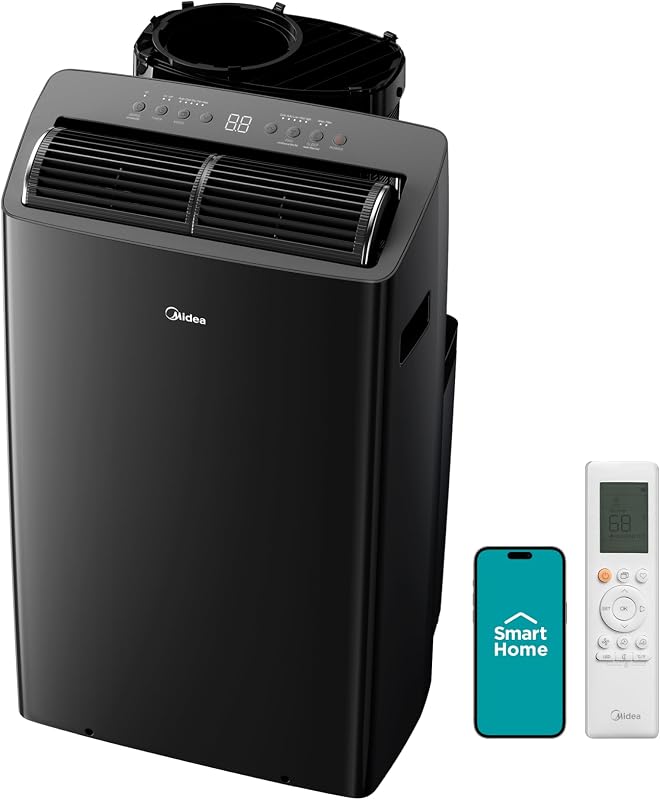
Whynter NEX ARC-1230WN vs Midea Duo: Which 14,000 BTU Portable AC Should You Buy?
Same capacity, same hose design, same noise class, same weight, same price band. Almost everything pages rank for on this comparison is a tie — including the two differences most often used to justify the price gap. What is left is room rating, price, and which company is willing to publish a number.
Both are 14,000 BTU / 12,000 SACC hose-in-hose dual-hose inverter units, both are rated at about 42 dB, and both weigh about 77 lb — so capacity, hose design, noise and weight do not decide this. Buy the Whynter NEX ARC-1230WN for the larger room rating (600 sq ft vs 550) and for the fuller published spec sheet, including 87 pints/day of dehumidification. Buy the Midea Duo to spend less. Both lines also sell a heat variant, so heat decides the SKU you order, not the brand.
Disclosure · As an Amazon Associate, BlackBox Supplies earns from qualifying purchases — at no extra cost to you. See our full disclosure.
01 / 10
Five things people think separate these units, and don't
Almost every page ranking for this query splits these two machines on capacity, on hose count, on noise, on weight, or on how much window they need. Checked against what the manufacturers actually publish on their own product pages, all five are ties — and several of them are ties in the direction that costs you money, because they push you toward the more expensive unit for something the cheaper one also has.
Capacity is the easy one. Whynter's own page for the ARC-1230WN gives it as "14,000 BTU (ASHRAE) 12,000 BTU (SACC)" — the ASHRAE headline and the DOE tested figure, side by side, which is more disclosure than most of this category offers. Midea markets the Duo as "12,000 BTU DOE" and does not print a 14,000 figure on its own page at all; the Amazon listing for the Duo we link carries both, as "14,000 BTU" in the title and "12,000 BTU SACC" beside it. Same headline number, same tested number. Whatever separates these machines, it is not how much heat they can move out of a room.
Hose design is the one that gets printed wrong most often, including in two earlier versions of this page. Everyone knows the Midea Duo is hose-in-hose — Midea's page says so: "an innovative hose-in-hose design that traps cool air and expels hot air." What almost nobody prints is that the Whynter is hose-in-hose too. Whynter's spec table reads "Hose System: Dual Hose (Hose-in-hose)", its feature list reads "Innovative Hose-in-hose Dual-Air System prevents Air backflow", and the replacement part it sells is an "Extendable Hose-in-Hose" assembly. Both units run the intake duct inside the exhaust duct and present one duct at the window. Neither one is the two-hose-bracket machine, and if you have read that the Whynter needs a wider window opening because it runs two ducts side by side, that is wrong — and it is the single most expensive error on this comparison, because it is used to justify a price premium that buys you nothing.
Noise is the third. Midea publishes "Ultra-quiet performance as low as 42 dBA." Whynter publishes "<42.5 dB low / 49.5 dB medium / 56.5 dB high". Half a decibel at the quiet end is well below what a person can hear — the just-noticeable difference for broadband noise is around a decibel in ideal listening conditions and larger in a real room. On published figures these two are equally quiet. The interesting part is not the gap, it is that only one of them tells you what happens above the lowest fan speed, which is covered further down.
Weight is the fourth, and the previous version of this page got it backwards in a way that changed the recommendation. Whynter's page says "Net weight: 77.25 lbs" (Amazon lists the same unit at 77.3 lb). Midea's page says "Product Weight (lbs) 74.96", and the with-heat Duo we link lists 77.2 lb on Amazon. These are the same weight. Anything you read claiming a ten-pound gap is almost certainly comparing one unit's net weight against the other's shipping weight — Whynter, to its credit, publishes both, and its gross weight is 88.5 lb.
Window opening is the fifth, and it is a tie by elimination rather than by matching figures. Whynter publishes a "3-piece window kit: 9.5″ wide, adjustable length up to 82”". Midea publishes no window-kit dimension at all. Since both units are hose-in-hose and present a single duct, there is no structural reason for one to need more clear width than the other, and there is no published number that would let anyone claim otherwise. Measure your opening before you buy either — that advice is sound — but do not let it pick between them.
That clears the table. What is left is a smaller set of real differences, and they are the ones the rest of this page is about.
02 / 10
BTU, SACC, and why the coverage numbers are the softest figures on the page
Before the differences, the arithmetic that decides whether either unit fits your room at all — because it is the same arithmetic for both, and it is where most portable AC disappointment comes from.
The two numbers on the box measure different things and only one of them is comparable across brands. A BTU is a unit of energy, and the ASHRAE headline rating on a portable air conditioner comes from a bench test under favourable conditions: it describes the refrigeration circuit, in isolation, doing its best work. SACC — Seasonally Adjusted Cooling Capacity — is the figure produced by the US Department of Energy's test procedure, and it is deliberately harsher. Whynter, which publishes an unusually candid explainer of this on its own product pages, describes SACC as "the Department of Energy's (DOE) 2017 standard for portable air conditioners" and notes that it accounts for heat added by the unit's own motor. It averages performance across hot and mild test conditions, and, critically, it subtracts the penalties a portable air conditioner inflicts on itself: the heat that radiates off the exhaust duct back into the room it just left, and the outside air pulled into the house to replace the air the unit blew out the window.
That is the whole reason a machine marketed at 14,000 BTU carries a 12,000 SACC rating. Neither number is a lie; they answer different questions. The headline number answers "how strong is the compressor?" The SACC number answers "how much of that reaches your room?" You want the second one, always, and on this pair the second one is identical. Whynter makes one further point worth carrying into any portable AC purchase: "A unit with dual hose design will generally have a higher SACC for the same ASHRAE rating" — which is exactly why both of these hold 12,000 SACC against a 14,000 ASHRAE headline while cheaper single-hose units at the same headline number fall to eight or nine thousand.
So what about the coverage claims — 600 sq ft for the Whynter, 550 sq ft for the Midea? That gap is not a capacity gap, because the capacity is the same. It is each manufacturer's own guidance about the size of room its unit suits, and there is no shared industry method behind those figures the way there is behind SACC. One brand may assume a shaded, well-insulated room; another may build in margin. A 50 sq ft difference across a 550–600 sq ft claim is about nine percent, which is comfortably smaller than the difference a west-facing window, an uninsulated top-floor ceiling, or two extra people in the room will make. It is a real difference and it is the largest single spec gap between these two units — but treat it as a tiebreaker, not a capacity verdict.
If you want a sizing sanity check that is not either company's marketing, Whynter publishes its own bands: up to 300 sq ft wants 8,000–10,000 BTU, 300–500 sq ft wants 11,000–14,000 BTU, and 500+ sq ft wants 14,000 BTU or more, with the advice to "consider ceiling height, sun exposure, and appliance heat when sizing." Those bands are stated against the ASHRAE headline number, which is the softer of the two — our own view is that you should run the same logic against SACC instead and add margin for direct sun, a top floor, a kitchen, poor insulation and the number of people in the room. On the widely used rough rule of about 20 BTU per square foot, 12,000 SACC is 600 sq ft in easy conditions, and a hot, sun-facing, poorly insulated room will want meaningfully less than that. Both of these units land in the same place on that arithmetic.
03 / 10
The head-to-head, on published specs only
Below is what each manufacturer publishes on its own product page, plus a small number of figures that come from the Amazon listings or from our own portable-AC comparison dataset rather than from the maker — those are labelled as such, and we do not pass them off as manufacturer specs. We research and cite specifications; we do not lab-test units, and we are not going to pretend otherwise by inventing a number to complete a row. Where a row says "not published," that is the finding, not a gap we filled in.
Whynter NEX ARC-1230WN vs Midea Duo — manufacturer figures unless noted
Whynter NEX ARC-1230WN
Midea Duo
Headline capacity
14,000 BTU (ASHRAE), per Whynter
14,000 BTU, per the Amazon listing; Midea's own page says 12,000 BTU DOE
Tested capacity (SACC / DOE)
12,000 SACC, per Whynter
12,000 BTU DOE, per Midea — identical
Maker's room rating
Up to 600 sq ft
Up to 550 sq ft
Compressor
NEX inverter
Smart inverter — "over 40% energy savings compared to the US federal standard," per Midea
Hose configuration
Dual hose, "Hose-in-hose", per Whynter
Dual hose, "innovative hose-in-hose design", per Midea
Published noise
<42.5 dB low / 49.5 dB medium / 56.5 dB high, per Whynter
"As low as 42 dBA", per Midea — low setting only, nothing published above it
Modes
Auto, cool, dehumidify, fan — no heat on this model
Cool, dehumidify, ventilate on MAP14S1TBL; heat on the MAP14HS1TBL variant
Smart control
Wi-Fi, Alexa, Google Home, NetHome Plus app
App plus Alexa and Google
Condensate handling
"Upper and lower drain ports for continuous operation" plus self-evaporation, per Whynter; the Amazon title adds "Built In Dehumidifier with Auto Drain"
Not published on Midea's spec page; our catalog describes it as self-draining
Dehumidification rate
87 pints/day, per Whynter
Not published
Efficiency
CEER 13.8 / EER 10.8, per Whynter
Not published as CEER or EER
Weight
77.25 lb net / 88.5 lb gross, per Whynter
74.96 lb, per Midea (77.2 lb for the with-heat SKU, per Amazon)
Window kit
Included; "9.5″ wide, adjustable length up to 82”", per Whynter
Included; no dimension published
Approximate street price
$550–$720
$500–$650
04 / 10
What actually separates them: room rating, price, and what each company will put in writing
Strip out the ties and three differences remain. None of them is dramatic, all of them are real, and one of them is a different kind of difference from the other two.
The first is the room rating — 600 sq ft against 550. As set out above, that is manufacturer guidance rather than a capacity difference, and nine percent is inside the noise of how sunny your room is. But it is the largest published gap between the two, and if your room is genuinely at the top of the range it is a reasonable tiebreaker in the Whynter's favour. Nothing more than that: if your room is 350 sq ft, the difference is meaningless to you.
The second is price, and it is the only difference on this page that everybody can feel. The Midea sits at roughly $500–$650 and the Whynter at roughly $550–$720. On the low end of both bands that is fifty dollars; on the high end it is seventy. For two machines this closely matched, the cheaper one has an honest claim on the default. The old argument for the premium — that the Whynter's dual-hose design was the exclusive one — does not survive contact with either manufacturer's spec table, and neither does the ten-pound weight gap that was supposed to soften it.
The third is not a spec, it is a disclosure difference, and it is the one we would actually weight heavily. Whynter publishes a full noise curve ("<42.5 dB low / 49.5 dB medium / 56.5 dB high"), a dehumidification rate (87 pints per day), a drainage arrangement ("Upper and lower drain ports for continuous operation"), a window-kit dimension, a CEER and an EER. Midea publishes a low-setting decibel figure, a room size and a weight, and its spec table stops. That is not proof the Midea is worse at any of those things — it is not — but it means that on four of the five questions a buyer usually asks second, you can check the Whynter's answer and you cannot check the Midea's. If you are the kind of buyer who wants to know what the machine does on high before it is in your bedroom, that asymmetry is worth more than the fifty dollars.
Dehumidification is where that asymmetry bites hardest. The Whynter publishes 87 pints per day and two drain ports; its Amazon title leads with "Built In Dehumidifier with Auto Drain." Midea publishes no moisture-removal rate and no drainage row at all — the self-draining description in our own catalog is ours, not Midea's. In a genuinely humid climate, plan for a drain hose and a floor drain or a condensate pump regardless of which unit you buy: every self-evaporating design in this category is conditional on the weather, and Whynter says as much itself, warning that in humid climates the unit "condenses more water than auto-evaporation removes through the exhaust" and will show a full-tank code until you drain it. Our own reservation about the Duo — that in very humid conditions the self-drain will not keep up — is our editorial judgement about the category, not something Midea has conceded.
A dual-hose 14,000 BTU inverter AC that cools up to 600 sq ft faster and more efficiently than single-hose units, with quiet operation and Wi-Fi control.
The heat mode: both lines have one, so it decides the SKU, not the brand
This section used to say that heating was the one either/or difference between these two machines and that only the Midea line offered it. That was wrong, and it is worth correcting loudly, because it is the claim most likely to have you order the wrong box.
Whynter sells the ARC-1230WNH — the same NEX platform as the unit on this page, titled "Whynter ARC-1230WNH NEX Inverter 14,000 BTU (ASHRAE) 12,000 BTU (SACC) Smart Control Dual Hose Portable Air Conditioner with Heat," with the same 600 sq ft rating, the same noise figures and 12,000 BTU of heating capacity. Midea sells a with-heat Duo too. Both companies therefore ship a cooling-only unit and a cooling-plus-heat unit under names one letter apart, and the letter is the whole difference. Heat does not choose your brand here. It chooses which model number you type into the search box.
The model numbers are where this goes wrong in real carts, so here they are plainly. Whynter: ARC-1230WN is the cooling unit — its own spec sheet lists "Four operational modes: Auto, Cool, Dehumidify, and Fan" and no heat — while ARC-1230WNH is the one with heat. Midea: MAP14S1TBL is the cooling unit, and Midea's specification table for it is unambiguous, with a "Comfort Features" row reading "Cool, Dehumidify, Ventilate" and a dedicated "Heat" row reading "No". The Duo listing we link is a different model number — the Amazon page records it as MAP14HS1TBL-A, with an H — and it is titled "Midea Duo 14,000 BTU Portable Air Conditioner with Heat." Our own catalog currently files that ASIN under the no-H model number, which is a mistake on our side and one we are fixing rather than dressing up as a manufacturer inconsistency.
How it heats matters more than whether it heats, because the two mechanisms cost very different amounts to run. A reverse-cycle heat pump moves existing heat indoors and can therefore deliver more heat energy than the electricity it draws. A resistive element is a space heater in an expensive chassis and cannot. Both of these with-heat variants are heat pumps and both makers say so: Whynter describes its heat function as "reverse air conditioning, or a heat pump," and Midea's own listing copy for the Duo we link states that the "Heat pump's operating temperature range is: 41℉-86℉". That temperature floor is the important number, and Whynter states the same one for the same reason — below about 41°F "there isn't enough heat in the outside air for the heat pump to operate efficiently, which can reduce performance or prevent heating altogether."
So read a portable's heat mode as a shoulder-season feature, and read that 41°F floor as the reason. It is for the chilly October evenings before the building turns the heating on, the spring mornings after it turns it off, the converted garage or home office that has no heating zone of its own. It is not a furnace substitute in deep winter — not as a matter of brand or build quality, but because the physics it depends on runs out at roughly the temperature at which you start wanting it most. Whether it is worth anything to you is a question about your building, not about the air conditioner. If you have central heating that reaches the room, it is a line item you will use twice a year. If you do not, it is the difference between owning one appliance and owning two, and the second appliance also needs somewhere to live for the eight months it is not in use.
The practical instruction, whichever brand you land on: confirm the word "heat" appears in the listing title and the feature list, and read the model number in the listing's own specification block before you order. Do not infer heating from the name "Duo" — that name refers to the hose-in-hose design, not to dual-season operation — and do not infer it from "NEX" either.
Both are inverters, and that is the part people overestimate
A lot of the marketing energy around both units goes into the word "inverter," so it is worth understanding what it buys — mostly so you can stop weighing it, because both of these have it and it cannot separate them.
A conventional portable air conditioner's compressor is a switch. It runs at one speed — full — or it does not run at all. The thermostat lets the room drift a degree or two above the setpoint, slams the compressor on, overshoots a degree or two below, and shuts it off. That cycle is why a cheap portable AC has a personality: the thump as the compressor engages, the rising drone, the silence, the thump again. It is also why the room temperature is never actually the number on the display; it is a sawtooth oscillating around it.
An inverter compressor is driven by a variable-frequency drive, which means its speed is continuously adjustable. Instead of switching on at full power, it works out how much cooling the room is losing and runs at exactly that rate — often a low, steady rate for hours. Three things follow. The room holds a genuinely constant temperature instead of sawtoothing around one. The unit is more efficient at part load, because a compressor spinning slowly in a steady state wastes far less energy than one repeatedly hammering from a standstill to full speed — Midea puts a number on that, claiming "over 40% energy savings compared to the US federal standard." And the noise stops changing, which matters more than the noise being low.
That last point is the one worth internalising, because it is what people are actually buying when they buy quiet. Human hearing is built to ignore steady sound and to notice change. A constant low hum tends to disappear within minutes; a unit that swings audibly between a quiet idle and full compressor every few minutes will wake you at three in the morning for weeks. An inverter's real bedroom advantage is not a lower peak, it is the absence of the transition.
Both of these units are inverters. Whichever one you buy, you get that. It is a strong reason to choose either of them over a fixed-speed portable AC at half the price, and no reason at all to choose one of them over the other.
07 / 10
What a 42 dB rating is worth, and the one place the two disclosures differ
Since both machines land at about 42 dB on their quietest setting, the number stops being a comparison and becomes a question of what to expect from either of them. It is genuinely useful and also routinely over-read, so both halves are worth setting out — and there is one real difference hiding in how the two companies report it.
For scale: a quiet suburban bedroom at night sits around 30 dB, a library reading room around 40, ordinary conversation around 60. The decibel scale is logarithmic, and the rule of thumb people use is that a 10 dB increase is perceived as roughly twice as loud. So 42 dB is a real, low number — closer to a library than a conversation, and low enough to sleep next to. That is a good argument for either of these units in a bedroom.
Here is the difference. Whynter publishes the whole curve: "<42.5 dB low / 49.5 dB medium / 56.5 dB high". Midea publishes only the floor — "as low as 42 dBA" — and nothing about what the Duo does on medium or high. Both units are quiet at their quietest. Only one of them tells you what happens when the room is genuinely hot and the fan steps up, and on the Whynter's own numbers that is a 14 dB climb from low to high, which the 10 dB rule of thumb makes roughly twice as loud again. Whynter's general guidance for the category says most portable units "operate between 50–60 dB" in normal use, which is a more honest picture of what you will actually live with than either unit's headline figure. There is no reason to assume the Duo behaves differently — it simply does not say.
Now the caveats, none of which make the numbers wrong. Manufacturers choose the conditions their acoustic figure is measured under, and a published low figure of this kind describes the quietest normal operating point: lowest fan speed, compressor modulating gently, measured at a stated distance in a room that does not reflect much sound. Your bedroom is not that room. Hard floors, bare walls and a glass window behind the unit all add reflected sound. The exhaust duct, which is a long tube of moving hot air, radiates noise along its whole length, and where the window bracket contacts the frame it can transmit low-frequency vibration into the structure of the house. A 42 dB rating means the unit is capable of 42 dB; it does not promise 42 dB at your pillow during a heatwave.
One practical note that applies to both: fan speed, not compressor speed, is what you actually hear most of the time on an inverter unit at steady state. If you are borderline on noise, a slightly oversized unit run permanently on low is quieter than a right-sized one run on medium, which is one of the few arguments for buying more capacity than your room needs — and it is the argument that most favours these two 12,000 SACC machines in a mid-sized bedroom.
08 / 10
Why dual-hose matters — and why it cannot pick a winner here
Because both of these are dual-hose, and both achieve it the same way, this section is background rather than a deciding factor. It is worth two minutes anyway, because it explains why both units cost more than the crowd of $300 portables and why that premium is defensible.
A single-hose unit uses room air to cool its condenser and blows that air out the window, which drops the room's pressure slightly below outside and pulls warm unconditioned air back in through every gap in the building. You are paying to cool air and then paying again to replace it with hot air from outdoors. A dual-hose unit draws condenser air from outdoors through a second duct and returns it outdoors, so the heat-rejection loop never touches the air you are paying to cool. The payoff shows up as faster cooling and better performance in large, sunny, hot rooms — and it is close to invisible in a small shaded bedroom, where the infiltration penalty was never large to begin with. It also shows up in the numbers on the box: Whynter's own explainer notes that a dual-hose design "will generally have a higher SACC for the same ASHRAE rating," which is exactly why both of these hold 12,000 SACC where a single-hose 14,000 BTU unit does not.
Hose-in-hose is how both of them do it. The intake duct runs concentrically inside the exhaust duct, so the machine gets two air paths while presenting one duct at the window. Midea calls it "an innovative hose-in-hose design that traps cool air and expels hot air"; Whynter calls it an "Innovative Hose-in-hose Dual-Air System" and lists the hose system in its spec table as "Dual Hose (Hose-in-hose)". Same idea, same install footprint, and there is no published figure on either side that would let anyone rank one arrangement above the other. We have written the dual-hose argument out properly, with the decision rule by room size and sun exposure, in the single-hose vs dual-hose guide linked below.
The reason this matters for this page is subtractive: if you arrived here believing dual-hose — or a narrower window install — was one unit's exclusive advantage, that belief was doing a lot of work in justifying a price gap, and it should stop.
09 / 10
A lot of people reading this should buy neither one
It would be easier to end with a pick. But four groups of people arrive at this comparison and should leave it without buying either unit, and saying so is more useful than a verdict.
If you can install a window air conditioner, install one. A portable air conditioner is inherently less efficient than a same-capacity window unit — that is our assessment of the format, not a concession either manufacturer makes, and the reason is structural rather than a matter of build quality. A window unit puts the entire hot half of the machine — condenser, condenser fan, all the heat being rejected — physically outside the building. A portable keeps the whole machine inside the room and pipes the heat out through a flexible duct that radiates warmth back into the space along its entire length. Dual-hose designs like these two reduce the infiltration half of that penalty but cannot remove the duct-radiation half. Portables exist for rooms where a window unit is impossible: rented flats with clauses about it, buildings with rules, casement windows, rooms where you cannot lose the light. Those are good reasons. "It seemed easier" is not, and it costs you efficiency for the life of the unit.
If your room is under about 300 sq ft and shaded, 12,000 SACC is more capacity than you need — Whynter's own sizing bands put a room that size at 8,000 to 10,000 BTU — and oversizing is not free. An oversized air conditioner reaches the temperature setpoint quickly, before it has run long enough to condense much moisture out of the air, and a room that is cold but still humid feels clammy rather than comfortable. Inverter compressors mitigate this considerably — that is precisely what modulating down to a low steady output is for — so it is much less punishing on these two units than it would be on a fixed-speed machine. But you would still be paying $500 or more for capacity a $300 unit would cover.
If you have no window at all, neither unit solves your problem, and no full-room portable AC does. Both need to reject heat outdoors through a duct. A unit sitting in a sealed windowless room is a net heater — it consumes electricity and dumps every watt of it, plus the heat it moved, back into the same air. That is not a brand limitation; it is thermodynamics, and it is worth stating plainly because the category's marketing photography rarely shows the window. Venting through a wall, a drop ceiling or a sliding door is a real alternative; venting into the room is not.
And if you need to move the unit between rooms every day, look at something much smaller. Fourteen thousand BTU of compressor, coil and casing is a 77 lb object on both of these, on a chassis a little over 32 inches tall, and re-seating a window kit is not a two-minute job on either of them.
10 / 10
The decision, in three questions
Here is the whole decision twice over: first as three questions to run in order, then as a lookup table. Stop at the first question that answers for you. Note what is missing from the list — capacity, hose design, noise, weight and window width, because on this pair every one of those is a tie.
Room to unit, at a glance
Your situation
The pick
Why
550–600 sq ft living room, west-facing
Whynter NEX
600 sq ft rating is the largest published gap between them
Humid climate, moisture is the problem
Whynter NEX
87 pints/day and two drain ports published; Midea publishes neither
You want to know how loud it gets on high
Whynter NEX
Publishes 42.5 / 49.5 / 56.5 dB; Midea publishes only the 42 dBA floor
Cheapest way into this class
Midea Duo
$500–$650 against $550–$720
You want heat as well as cooling
Either — buy the H model
Both lines sell one: Whynter ARC-1230WNH, Midea MAP14HS1TBL
Narrow or restricted window opening
Either
Both are hose-in-hose and present one duct — measure, but it does not pick
You will carry it upstairs
Either
Both are about 77 lb — there is no lighter one
Bedroom, light sleeper
Either
Both are inverters rated about 42 dB on low — this is a tie
Under ~300 sq ft and shaded
Neither
12,000 SACC is overkill; spend less
A window you are allowed to fit a unit in
Neither
A same-capacity window unit is structurally more efficient
No window at all
Neither
Both must reject heat outdoors; no portable AC escapes this
Is the room at the top of the range, 550–600 sq ft, or open-plan? — Take the Whynter. Its 600 sq ft rating against the Midea's 550 is the largest published spec gap between them. It is manufacturer guidance rather than a capacity difference — the SACC figures are identical at 12,000 — so treat it as a tiebreaker, and add margin for sun and insulation either way. If your room is comfortably inside both ratings, this question does not answer for you and you should move on.
Do you want to be able to check the spec before it arrives? — Take the Whynter. It publishes a full noise curve, 87 pints/day of dehumidification, its drain ports, its window-kit width, a CEER and an EER. Midea's spec table for the Duo publishes a room size, a low-setting decibel figure and a weight, and stops. That is not evidence the Duo is worse at anything — it is an absence of evidence either way, and how much that bothers you is a genuine preference, not a spec.
Otherwise, buy on price. — The Midea is fifty to seventy dollars cheaper across its band — $500–$650 against $550–$720. They are the same capacity, the same hose design, the same noise class and the same weight, so once the room rating and the disclosure question are settled, price is the meaningful variable and the cheaper one wins by default. Separately, if you want heat, buy the with-heat model number in whichever line you have chosen: Whynter's ARC-1230WNH or Midea's MAP14HS1TBL. Heat is not a reason to switch brands.
A dual-hose 14,000 BTU inverter AC that cools up to 600 sq ft faster and more efficiently than single-hose units, with quiet operation and Wi-Fi control.
Whynter ARC-1230WN vs Midea Duo — which is better?
Neither is better outright, and they are far more alike than most comparisons suggest. They share the same 12,000 SACC tested capacity, both are hose-in-hose dual-hose inverter units, both are rated at about 42 dB on their lowest setting, and both weigh about 77 lb. The Whynter NEX wins on room rating (600 sq ft vs 550) and on disclosure — it publishes a full noise curve, 87 pints/day of dehumidification, its drain ports, a window-kit dimension, a CEER and an EER, where Midea's spec table publishes a room size, a weight and one decibel figure. The Midea Duo wins on price, at $500–$650 against $550–$720. Heat is not a differentiator: both lines sell a with-heat variant.
Is the Midea Duo single-hose or dual-hose?
Dual-hose. Midea's specification describes "an innovative hose-in-hose design that traps cool air and expels hot air": the intake duct runs inside the exhaust duct, so it gets the dual-hose benefit — drawing condenser air from outdoors rather than from your room — while presenting a single duct at the window. If you have read that the Duo is single-hose, that is wrong. It is also worth knowing that the Whynter ARC-1230WN is built the same way — its own spec table lists its hose system as "Dual Hose (Hose-in-hose)" — so this is not a point of difference between these two units at all.
Does the Whynter need a wider window opening than the Midea Duo?
No. That claim comes from the belief that the Whynter runs two separate ducts side by side, and it does not — Whynter lists its hose system as "Dual Hose (Hose-in-hose)", the same concentric arrangement Midea uses, so both units present one duct at the window. Whynter publishes a "3-piece window kit: 9.5″ wide, adjustable length up to 82”"; Midea publishes no window-kit dimension at all, so there is no figure on either side that would support ranking them. Measure the clear opening your sash actually leaves you before buying either — that part is good advice — but it will not choose between them.
Which one is lighter?
Effectively neither. Whynter publishes a net weight of 77.25 lb for the ARC-1230WN and Amazon lists it at 77.3 lb. Midea publishes 74.96 lb for the MAP14S1TBL, and the with-heat Duo we link is listed at 77.2 lb on Amazon. That is a spread of about two pounds across four figures. If you have seen a ten-pound gap quoted, it is almost certainly a net weight being compared against a shipping weight — Whynter publishes both, and its gross weight is 88.5 lb. Neither of these is a unit you will casually move between rooms.
Is the Midea Duo actually quieter than the Whynter NEX?
No — at their quietest they are effectively the same. Midea publishes "ultra-quiet performance as low as 42 dBA"; Whynter publishes "<42.5 dB low". Half a decibel is below the threshold at which a person can hear a difference. The real distinction is what happens above that: Whynter also publishes 49.5 dB on medium and 56.5 dB on high, and Midea publishes nothing above its floor. Both use inverter compressors, so both avoid the loud on/off cycling of fixed-speed units, which is the bigger factor in whether a unit wakes you.
Do they cool the same amount of space?
Effectively yes. Whynter's page gives the ARC-1230WN as "14,000 BTU (ASHRAE) 12,000 BTU (SACC)"; Midea markets the Duo as "12,000 BTU DOE" on its own page, and the Amazon listing carries the same pairing as 14,000 BTU with 12,000 BTU SACC. The difference in advertised coverage, 600 sq ft for the Whynter and 550 sq ft for the Midea, is each manufacturer's own room guidance rather than a capacity difference, and nine percent is smaller than the effect of direct sun or a poorly insulated ceiling. Compare portable ACs by SACC, and treat coverage claims as a starting point.
Does the Midea Duo have a heat mode?
It depends on the model number, and the two are one letter apart. Midea's specification page for MAP14S1TBL lists its comfort features as "Cool, Dehumidify, Ventilate" and carries a "Heat" row reading "No" — that is the cooling-only Duo. The listing we link is the other one: Amazon records its model number as MAP14HS1TBL-A and titles it "Midea Duo 14,000 BTU Portable Air Conditioner with Heat." Confirm the word "heat" appears in the title and the feature list and read the model number in the listing's own specification block before ordering. Do not infer heating from the name "Duo" — that refers to the hose-in-hose design, not to dual-season operation.
Does the Whynter NEX come with a heat mode?
Not this model, but the line has one. The ARC-1230WN on this page is cooling-only — Whynter lists "four operational modes: Auto, Cool, Dehumidify, and Fan." Whynter also sells the ARC-1230WNH, titled "...Dual Hose Portable Air Conditioner with Heat," on the same NEX platform with the same 14,000 BTU (ASHRAE) / 12,000 BTU (SACC) cooling figures, the same 600 sq ft rating and 12,000 BTU of heating. So heating does not decide which brand to buy here — both lines offer it, and it decides which model number you order.
Does a portable AC heat mode replace a space heater or a furnace?
No — treat it as supplemental heat, and the reason is a specific number. Both of these with-heat variants are heat pumps: Whynter describes its heat function as "reverse air conditioning, or a heat pump," and Midea's listing for the with-heat Duo states that the "heat pump's operating temperature range is: 41℉-86℉". A heat pump moves existing heat indoors rather than generating it, which makes it efficient in mild cold and progressively less effective as the outdoor temperature drops — Whynter puts the practical floor at about 41°F, below which "there isn't enough heat in the outside air for the heat pump to operate efficiently." Its real value is that one appliance covers both seasons, which also halves the off-season storage problem. It is not a substitute for a furnace in deep winter.
Should I just buy a window air conditioner instead?
If you are allowed to fit one, probably. A window unit puts the entire hot half of the machine outside the building, while a portable keeps all of it in the room and pipes heat out through a duct that radiates warmth along its length. Dual-hose designs like both of these reduce the infiltration penalty but cannot remove the duct-radiation one, which is why a portable is still less efficient than a same-capacity window unit. Buy a portable when a window unit is genuinely not an option: rental restrictions, casement windows, or a room where you cannot lose the light.
The gear actually worth buying — one email a week.
The car, power, cooling, and work-utility gear worth owning — with the honest catch on each. One genuinely useful email a week. No spam, no fake reviews, unsubscribe anytime.
No spam
One email a week
Unsubscribe anytime
Top pick
Whynter NEX ARC-1230WN 14,000 BTU Dual-Hose Inverter Portable Air Conditioner · $550-$720 recently seen