

Power & Charging
Anker SOLIX C300 Portable Power Station
$179-330
288Wh LiFePO4 compact power station with 300W AC output.
Affiliate linkPortable power station vs jump starter — which do I need for my car? They solve two different problems: a jump starter dumps a huge amp burst to crank a dead engine, while a power station stores watt-hours to run your gear and usually can't crank a car at all. Here's how to tell which one (or both) you actually need.
A jump starter and a portable power station solve different problems, so the right answer depends on what failed. Buy a jump starter (like the NOCO GB70) to restart a dead battery — it delivers a huge amp burst to crank the engine. Buy a power station (like the Jackery Explorer 1000 v2) to run devices — phone, fridge, CPAP — off-grid. Most power stations can't crank a car. If you want one box that does both, a hybrid like the DeWalt DXAEPS14 is the honest compromise.
Disclosure · As an Amazon Associate, BlackBox Supplies earns from qualifying purchases — at no extra cost to you. See our full disclosure.
These two boxes look like rivals on the shelf and get cross-shopped constantly, but they aren't the same tool at all. A jump starter exists for one job: turn a dead engine over. A power station exists for a completely different job: keep your electronics and small appliances running when there's no wall outlet.
The confusion is understandable — both are lithium batteries in a rugged case, both charge your phone, and marketing on both sides is happy to blur the line. But the moment you name the failure you're solving for, the choice gets simple. Dead battery, need to drive away? Jump starter. Stranded, camping, or riding out a blackout and need to power things? Power station. The rest of this page is why, and what to buy for each.
Start with the symptom, not the spec sheet. The two products almost never overlap in the moment you need them.
If your problem is that the engine won't crank — the classic click-click of a dead 12V battery — you need a jump starter, and a power station will not help you. If your problem is that your devices are dead and there's no outlet — a weekend at a campsite, a multi-day outage, a CPAP that has to run all night — you need a power station, and a jump starter will barely dent it. The failure names the tool.
The only people who genuinely need both are those exposed to both failures far from help: overlanders, van-lifers, and long-haul road-trippers. For them these aren't competing purchases — they're two different layers of the same kit (more on that at the end).
Every bit of this comes down to two numbers that measure two different things, and product listings love to mix them up.
Peak amps (A) measure a burst of current — how hard a battery can shove electricity for a moment. Cranking an engine is a brutal, brief demand: the starter motor pulls hundreds of amps at 12 volts for two or three seconds. Jump starters are engineered around exactly that burst, with high-discharge cells and heavy clamps whose only purpose is to dump current fast. The NOCO GB70's headline number is 2000 peak amps; that's the language of cranking.
Watt-hours (Wh) measure stored energy — how much work a battery can do over time. Running a mini-fridge or charging a laptop is a small, steady draw for hours, and that's what a power station is built for. The Jackery Explorer 1000 v2 is rated at 1,070Wh; that's the language of running things. Notice the power station never advertises peak amps, and the jump starter never advertises watt-hours — because each is selling the number that matters for its job.
Here's the counterintuitive part: the Jackery holds dozens of times more total energy than a pocket jump starter, yet the little pack starts your car and the big one can't. Storage isn't the problem — delivery is. A power station simply isn't wired to release its energy as a giant instantaneous burst.
The specific reason lives in the 12V output port. On a power station, that cigarette-lighter-style DC port is a regulated accessory outlet, and it's usually capped around 10 amps — roughly a hundredth of what a starter motor demands. Ask it to crank an engine and its protection circuitry does exactly what it's designed to do: it shuts the port down to protect the cells. Nothing about the 1,000Wh or 1,800W rating changes that; wattage is not cranking current.
This is why you should never buy a 1,000Wh power station expecting it to jump your truck. Unless a unit explicitly lists jump-starting with dedicated jumper clamps and a peak-amp rating, it cannot do it — and almost none of the pure power stations here (Jackery, EcoFlow, Bluetti, Anker) do.
One honest caveat in the other direction: a power station can slow-charge a dead car battery through a 12V maintainer over the course of several hours, then the car starts on its own recovered battery. That's a real trick for a driveway, not a roadside rescue. If you're stranded on a schedule, it's a science project — the jump starter in your glovebox is the actual rescue.
| Jump starter | Power station | Hybrid (does both) | |
|---|---|---|---|
| The job | Crank a dead engine | Run devices & appliances off-grid | A bit of both |
| Headline number | Peak amps (e.g. 2000A) | Watt-hours (e.g. 1070Wh) | 2000A + 500W inverter |
| Can it start a car? | Yes — that's the whole point | No (12V port ~10A) | Yes, 2000 peak amps |
| Can it run a fridge/CPAP for hours? | No | Yes | Briefly (small capacity + 500W) |
| Size / weight | Glovebox pack, ~2–3 lb | Duffel, 17–35 lb | Big case, heavier than a pocket pack |
| Example | NOCO GB70 ($150–195) | Jackery Explorer 1000 v2 ($449–799) | DeWalt DXAEPS14 ($200–250) |
Cold is the great revealer, and it hits the two tools differently. A dead battery is most likely on a freezing morning: the car's battery loses output as temperature drops while thickened oil makes the engine physically harder to turn, so the starter demands even more current exactly when there's less to give. That's a jump-starter moment, and lithium jump packs themselves crank weaker when the pack is frozen — keep it in the cabin or warm it inside your jacket for a few minutes before use.
Power stations feel cold in a quieter way. LiFePO4 cells (what the Jackery, EcoFlow, Bluetti, and Anker units here use) are durable and long-lived, but like all lithium they deliver less usable capacity in the cold, and many have a hard rule you can miss in the manual: they will not accept a charge below freezing without a heating feature. Plan to keep a power station insulated and, ideally, above freezing if you're relying on it overnight in winter.
The through-line: cold makes the jump starter's job harder and the power station's numbers softer. In a genuine winter-exposure situation, size up on the jump starter and don't count on a power station's rated capacity to the last watt-hour.
Power stations are bought by watt-hours (capacity) and inverter watts (how big an AC device they'll run at once), not by amps. Match the size to what you actually plug in — bigger isn't better, it's just heavier and pricier. All four below are researched from published manufacturer specs and owner reviews, not personally lab-tested, and prices are approximate ranges that move with sales.
Anker SOLIX C300 (288Wh, 300W AC, ~$179–330) — the grab-and-go pick for phones, laptops, and a CPAP on a plane or a day trip. It has fast 140W two-way USB-C and eight ports. The catch: two versions exist — get the AC model for wall-outlet devices; the cheaper DC model is USB-only. It won't run anything with a motor or heating element.
EcoFlow RIVER 2 Pro (768Wh, 800W AC, ~$369–399) — the road-trip sweet spot at 17 lb, recharging 0–100% in about 70 minutes. Enough to run a mini-fridge or CPAP overnight without hauling a 30-lb brick. The catch: native AC is 800W; its 1600W 'X-Boost' figure is for resistive loads only and won't run a 1500W microwave.
Jackery Explorer 1000 v2 (1070Wh, 1500W AC / 3000W surge, ~$449–799) — the definitive outage/road-trip hero: a real 1500W inverter that runs most car-camp gear, ~1-hour recharge, LiFePO4 rated for 4,000 cycles. The catch: 23.8 lb (a two-hand lift), MSRP $799 but frequently deep-discounted, so buy on sale — and it still cannot jump a car.
BLUETTI AC180 (1152Wh, 1800W AC / 2700W peak, ~$399–699) — the most headroom here: more capacity, a stouter inverter, a wireless pad, and 20ms UPS switchover, 0–80% in 45 minutes. The catch: ~35 lb makes it a haul-to-the-campsite unit, not a carry-around, and the solar panel is sold separately.
$179-330
288Wh LiFePO4 compact power station with 300W AC output.
Affiliate link
$369-399
768Wh LiFePO4 portable power station with a fast ~70-minute recharge.
Affiliate link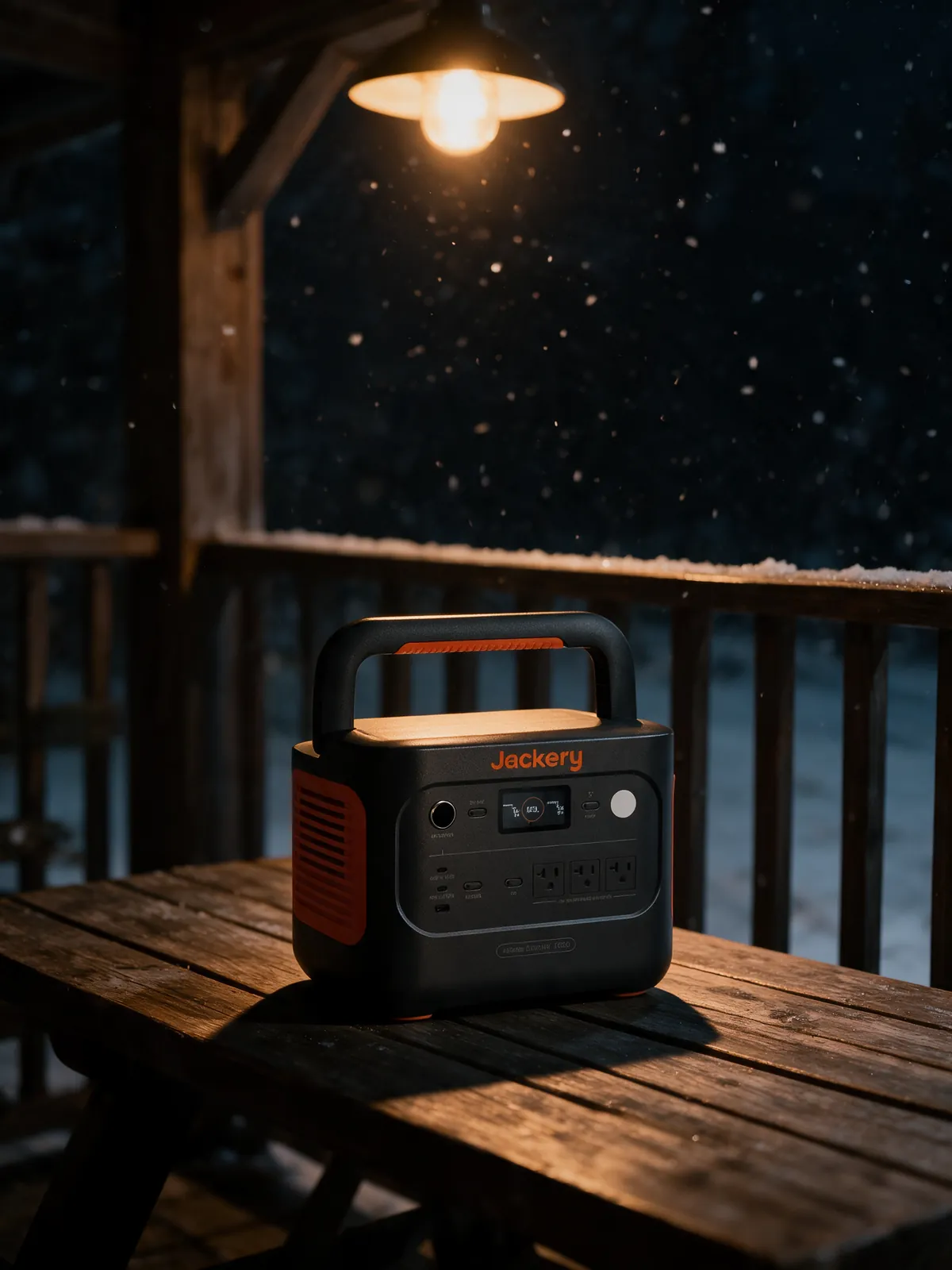
$449-799
1070Wh LiFePO4 portable power station with 1500W AC output.
Affiliate link
$399-699
1152Wh LiFePO4 portable power station with an 1800W inverter and UPS backup.
Affiliate linkFor the crank-the-engine job, buy for your engine size, not the biggest amp number. For most cars a 1000A-class pack like the NOCO GB40 (rated by NOCO for gas up to 6.0L / diesel up to 3.0L, ~$80–100) is plenty. Step up when the engine is bigger.
NOCO Boost HD GB70 (2000A, ~$150–195) is the honest pick for trucks, big SUVs, boats, RVs, and diesels — NOCO rates it for gas up to 8.0L and diesel up to 6.0L, about 40 jumps per charge, with the same spark-proof, reverse-polarity-protected clamps as the smaller GB40. The catch: it's bigger, heavier, and pricier than a compact pack, and genuinely overkill for a commuter sedan. Diesels matter here — they ignite by compression alone, so a diesel needs roughly twice the cranking power of a same-size gas engine, which is why a pack rated for a 6.0L gas V8 is only rated for a 3.0L diesel. If you drive a diesel pickup, skip the compact tier.
Whatever you buy, remember every lithium jump pack self-discharges: top it up every 3–6 months and before winter, or the rescue battery is a paperweight in a nice case the morning you need it.

$150-195
Heavy-duty 2000A 12V lithium jump starter for large gas and diesel engines, same UltraSafe protection as the GB40.
Affiliate link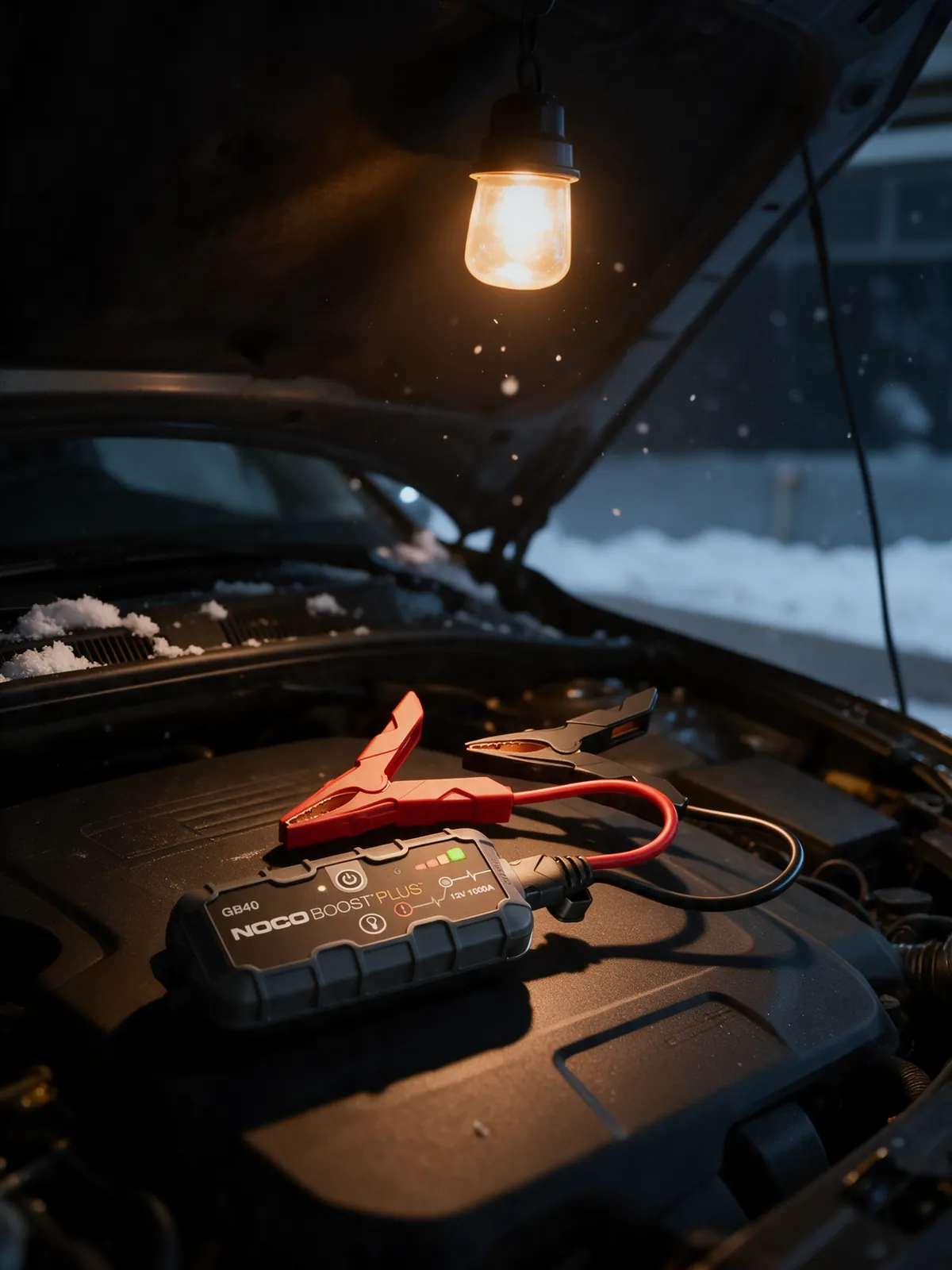
$80-100
Compact 1000A 12V lithium jump starter that lets a driver jump their own dead battery with no second car.
Affiliate linkA few units genuinely do both jobs, and the DeWalt DXAEPS14 (~$200–250) is the recognizable one: a 2000-peak-amp jump starter with dedicated clamps, plus a 120 PSI air compressor and a 500W AC inverter with USB ports. It really will crank a big engine, inflate a soft tire, and run a modest AC device — the do-everything garage box for a homeowner or road-tripper who wants one rugged unit.
Now the honest catch, because this is where buyers get burned. A hybrid is a jump-starter-first box with a small power station bolted on — not a replacement for a real 1,000Wh station. Its 500W inverter and modest internal capacity will charge devices and run a small load briefly; they will not run a fridge, cooler, and lights across a two-night campsite the way a Jackery or Bluetti will. And in the other direction, it's far bulkier and pricier than a $150 pocket jump starter if cranking is all you ever need.
So the hybrid is the right answer for exactly one person: someone who wants a single unit for occasional both-jobs use and accepts a compromise on each. If either job is your main need, a dedicated tool does it better for the money.

$200-250
Premium do-everything station: 2000-peak-amp jump starter plus a 120 PSI digital air compressor, a 500W AC inverter, and USB ports.
Affiliate linkFor most drivers, the honest answer is one or the other. A city commuter who parks in a garage needs a jump starter in the trunk and probably nothing else. A tailgater or apartment-dweller who wants outlet power at the park needs a power station and can jump-start with cables or a cheap pocket pack on the rare occasion.
The genuine both-buyers are people exposed to both failures far from help: overlanders, van-lifers, and long road-trippers. Their kit is layered — a dedicated jump starter for the crank-the-engine failure that a power station can't touch, and a power station sized to their nights off-grid for everything the jump starter can't run. A neat bonus of carrying both: the power station keeps the jump starter topped up over USB on a long trip, so the rescue pack is never the thing that died.
Everyone else: name the failure you're most likely to face, buy the tool that solves it, and add the second only when your driving actually exposes you to the second failure. Our roadside-kit guide below maps the full trunk loadout and where each of these fits.
Almost never. A power station's 12V port is typically capped around 10 amps, while a starter motor draws hundreds — its protection circuit cuts out long before the engine turns. Only a unit that explicitly lists jumper clamps and a peak-amp rating (a jump starter, or a hybrid like the DeWalt DXAEPS14) can crank an engine. Watt-hours and inverter watts have nothing to do with cranking.
Name the failure. If the engine won't crank (dead battery), you need a jump starter like the NOCO GB70 — a power station won't help. If your devices are dead and there's no outlet (camping, an outage, a CPAP overnight), you need a power station like the Jackery Explorer 1000 v2 — a jump starter barely dents that job. They solve different problems.
Peak amps measure a burst of current — how hard a battery can shove electricity for a moment, which is what cranking an engine demands. Watt-hours measure stored energy — how much work a battery can do over hours, which is what running devices demands. A jump starter is rated in peak amps; a power station is rated in watt-hours. That's why each advertises a different number.
Yes — hybrids like the DeWalt DXAEPS14 pair a 2000-peak-amp jump starter with a 120 PSI compressor and a 500W AC inverter. The honest catch: it's a jump-starter-first box with a small power station attached, so it won't run a fridge across a multi-night campsite the way a 1,000Wh Jackery or Bluetti will, and it's bulkier than a pocket jump starter. Good for occasional both-jobs use; a compromise on each.
It's about delivery, not storage. A power station holds far more total energy but releases it slowly through a regulated port; a jump starter is wired to dump a massive burst of current for a few seconds through heavy clamps. Cranking needs the burst, not the total energy — so the small pack built for it wins.
Yes, over USB — and it's a genuinely useful pairing on a long trip: the station keeps the rescue pack topped up so it's never the thing that died. A power station can also slow-charge a dead car battery through a 12V maintainer over several hours, but that's a driveway trick, not a roadside rescue.
Research-driven: our picks come from verified manufacturer specs and long-term owner feedback. How we work: our methodology.
The car, power, cooling, and work-utility gear worth owning — with the honest catch on each. One genuinely useful email a week. No spam, no fake reviews, unsubscribe anytime.