
Tire Inflators
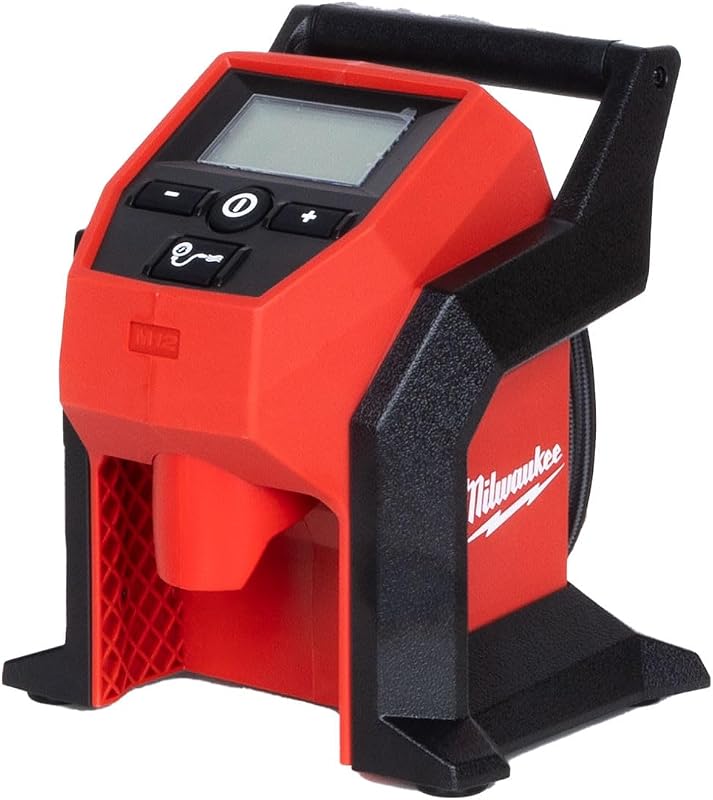
Milwaukee M12 Compact Inflator 2475-20 (Bare Tool)
$99 (tool only)
Milwaukee's 'fastest cordless' reputation and jobsite durability.
Affiliate linkMilwaukee M12 vs DeWalt 20V inflator, and which bare tool to buy — the ecosystem-specific answer most listicles skip: for platform owners, the right pick is almost always the brand you already own.
If you already own the batteries, buy the inflator that matches your platform — Milwaukee M12 owners get the 2475-20, DeWalt 20V MAX owners get the DCC020IB, and the money you save on a second charger dwarfs any spec difference. If you own neither battery yet, a bare tool is a false bargain: buy a self-contained inflator instead.
Disclosure · As an Amazon Associate, BlackBox Supplies earns from qualifying purchases — at no extra cost to you. See our full disclosure.
Almost every head-to-head treats these as two competing products you choose between on the merits. For the person actually searching this, that framing is wrong. A bare tool has no battery in the box — its whole reason to exist is to plug into a battery platform you already own. So the decision isn't really "Milwaukee vs DeWalt." It's "which color are the batteries already on my shelf?"
Own M12 batteries? Buy the Milwaukee 2475-20. Own DeWalt 20V MAX batteries? Buy the DCC020IB. That's the honest answer for maybe 80% of people reading this, and no spec sheet overturns it — because buying the off-platform tool means also buying a battery and a charger you don't need, which is $80–150 of dead weight to chase a difference measured in seconds and PSI.
The rest of this page is for the two groups that answer isn't enough for: owners who genuinely run both platforms and want the better tool, and first-time buyers who own neither battery yet (skip to the last section — a bare tool is probably the wrong buy for you).
Both units list around $99 as a "tool only" price. That number is honest only if you're already in the ecosystem. A bare tool ships with no battery and no charger. If you have to buy those too, the real cost of a single inflator can roughly double — and now you own a battery platform you didn't want, bought sideways through an air pump.
This is the trap the listicles bury: they compare the $99 sticker on the Milwaukee to the $99 sticker on the DeWalt as if those are the prices you pay. For an existing owner they are. For a first-time buyer, the true cost is inflator + battery + charger, at which point a self-contained 12V or all-in-one cordless unit that includes its own power is both cheaper and simpler.
| Your situation | What you actually pay | Right move |
|---|---|---|
| Already own M12 batteries | Tool only (~$99) | Milwaukee 2475-20 — no-brainer |
| Already own DeWalt 20V MAX batteriesCheck price on Amazon → | Tool only (~$99) | DeWalt DCC020IB — no-brainer |
| Own both platforms | Tool only, either color | Pick on size vs. speed/flex (below) |
| Own neither battery | Tool + battery + charger (roughly 2×) | Skip bare tools — buy self-contained |
These two tools split cleanly along one axis: the Milwaukee is the compact, grab-and-go unit; the DeWalt is the bigger, more flexible one. Neither is "better" in the abstract — they're optimized for different spots in your life.
Milwaukee 2475-20 (M12): rated to 120 PSI max, with TrueFill auto-shutoff, a backlit digital gauge, anti-vibration feet, and a 26-inch hose with a brass chuck. It runs on an M12 12V pack (sold separately). It's small enough to live in a glovebox or a jobsite bag — the portability is the point.
DeWalt DCC020IB (20V MAX): rated to 160 PSI max, and its headline feature is three power sources — the 20V MAX battery, a 12V DC car socket, or a 120V AC wall outlet. Digital gauge with auto-shutoff, a high-pressure hose, and an LED work light. DeWalt notes it runs around 77 dBA under load — audible, and worth knowing before you use it near sleeping kids in a garage at night. It's bulkier than the M12 and won't disappear into a glovebox.
| Milwaukee M12 2475-20 | DeWalt 20V MAX DCC020IB | |
|---|---|---|
| Platform | M12 (12V) | 20V MAX |
| Max pressure | 120 PSI | 160 PSI |
| Power sources | M12 battery only | 20V battery + 12V car + 120V wall |
| Auto-shutoff | TrueFill preset auto-stop | Digital preset auto-stop |
| Hose / chuck | 26 in, brass chuck | High-pressure hose |
| Light | — | LED work light |
| Noise | Not published | ~77 dBA under load (DeWalt) |
| Size / portability | Compact — glovebox-friendly | Bulkier — garage/trunk |
| Price (tool only) | ~$99 | ~$99 |
If you own both platforms, this is the real fork. The Milwaukee wins on being small: it's the one you toss in the door pocket and forget about until a tire reads low. The 120 PSI ceiling is plenty for car, truck, SUV, bike, and sports-ball duty — you only bump into it with specialty high-pressure applications, which is a narrow world.
The DeWalt wins on never being stranded for power and on raw pressure headroom. The 12V and 120V inputs mean a dead battery on the tool doesn't end the job — plug into the car socket or a wall outlet and keep going. That corded flexibility is genuinely useful as a driveway-and-trunk tool, and the 160 PSI rating covers a wider range of jobs. The costs are size and noise: it's a bigger box, and ~77 dBA is not a whisper.
Rule of thumb: choose the M12 if the inflator's job is to be everywhere and invisible; choose the DeWalt if its job is to be the one air source that always works, even when its own battery is flat.
Both units share the feature that makes a modern inflator worth owning: a digital preset with auto-shutoff. You dial in 36 PSI, squeeze the trigger, and walk away — it stops itself. That "set-and-forget" behavior is the entire ergonomic win over an old dumb compressor, and it's the same on both tools in practice.
One honest caveat on accuracy: portable inflator gauges are convenient, not laboratory instruments. Treat the on-tool reading as a close guide, not gospel — if a few PSI matters to you (tuning, track days, a TPMS light that won't clear), confirm final pressure with a dedicated stick or dial gauge. This is true of every portable inflator, not a knock on either brand.
Buy the Milwaukee 2475-20 if: you already run M12 tools and want a compact inflator that lives in the glovebox or the tool bag and just works.
Buy the DeWalt DCC020IB if: you already run DeWalt 20V MAX, and you want one inflator that covers the trunk emergency, the driveway session, and the wall-outlet garage job — with power backups so it's never dead when you need it.
Skip both if you own neither battery yet. This is the honest catch. A first-time buyer chasing a $99 sticker ends up at inflator + battery + charger — near double — for a platform they only wanted for one air pump. You're better served by a self-contained unit that brings its own power: a cheap 12V plug-in for pure trunk duty, or an all-in-one cordless inflator with a built-in battery. We break that exact decision down in our cordless-vs-12V guide, and both bare tools sit in our full tire-inflator comparison if you want to see them next to self-contained rivals.
$99 (tool only)
Milwaukee's 'fastest cordless' reputation and jobsite durability.
Affiliate link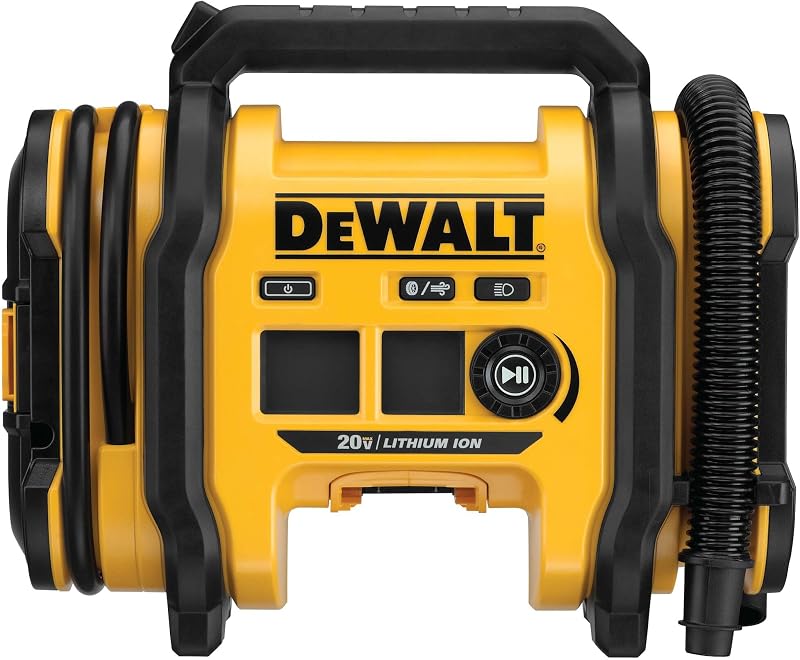
$99 (tool only)
A three-way inflator that runs off a DeWalt 20V MAX battery, a 12V car socket, or a 110V wall outlet.
Affiliate linkBuy whichever matches a battery platform you already own: the Milwaukee 2475-20 if you run M12, the DeWalt DCC020IB if you run 20V MAX. The savings on a second battery and charger outweigh any spec gap. If you own neither, skip bare tools and buy a self-contained inflator with its own power.
Usually not. A bare tool ships with no battery or charger, so a first-time buyer pays inflator + battery + charger — roughly double the sticker — plus inherits a battery platform they didn't want. A 12V plug-in or all-in-one cordless inflator that includes its own power is cheaper and simpler.
The Milwaukee M12 2475-20 is the more portable, glovebox-friendly unit. The DeWalt DCC020IB is bulkier but adds 12V car and 120V wall power inputs on top of its battery, so it can run even when its own pack is dead.
Both use a digital preset with auto-shutoff, which is accurate enough for everyday tire filling. For precision work, treat the on-tool reading as a close guide and confirm final pressure with a dedicated stick or dial gauge — that's good practice with any portable inflator, not a fault of either brand.
Research-driven: our picks come from verified manufacturer specs and long-term owner feedback. How we work: our methodology.
The car, power, cooling, and work-utility gear worth owning — with the honest catch on each. One genuinely useful email a week. No spam, no fake reviews, unsubscribe anytime.