

Tire Inflators
Fanttik X8 APEX Portable Tire Inflator (150 PSI Cordless)
$70-90
The flagship do-it-all cordless air compressor: dial in a target PSI, walk away, it auto-stops.
Affiliate link12V corded compressors run off the socket, so the battery can't run out mid-fill on a dead-flat SUV tire (they still need rests to cool on big jobs); cordless inflators are grab-and-go but can overheat or run out of battery on a big flat. Here's how to decide which to keep in your car — and when the answer is neither.
Keep a cordless inflator if you mostly top up slow leaks and want to grab it and go — the Fanttik X8 APEX or the pocket-sized AstroAI L7 both fill a car tire in a minute or two. Keep a 12V corded compressor like the EPAuto if you might face a dead-flat truck or SUV tire, drive in the cold, or hate charging things: it runs off the engine and never runs out of battery mid-fill, though it still needs rests on big jobs (AutoGuide: 10-minute recommended duty cycle). Own many big tires? The corded unit wins.
Disclosure · As an Amazon Associate, BlackBox Supplies earns from qualifying purchases — at no extra cost to you. See our full disclosure.
Both types hit the same pressures and both have set-it-and-walk-away auto-shutoff. The real split is power source, and that changes when the tool lets you down. Cordless dies when its battery dies; corded dies only when your car does. Everything below is a consequence of that one difference.
| If this is you… | Keep this | Because |
|---|---|---|
| Mostly topping up slow leaks, want grab-and-go | Cordless (Fanttik X8 APEX / AstroAI L7) | No cable, no engine running — done in ~1–2 min |
| Might face a dead-flat full-size truck/SUV tire | 12V corded (EPAuto) | Endless runtime off the car; still rests to cool on big tires |
| Cold-climate winters, sub-freezing mornings | 12V corded | No lithium pack to weaken or self-discharge |
| Refuse to maintain another battery | 12V corded | Works on day 1,000 exactly like day one |
| Filling many tires — family fleet, trailer, mower | 12V corded | One charge can't cover a whole session |
| Already own M12 or DeWalt 20V batteries | Bare-tool inflator | Cheapest good option — you own the power source |
The honest way to decide isn't specs — it's to picture the worst realistic moment. There are two, and they favor opposite tools.
The first is the top-up: a tire reading 26 PSI on a cold morning, or a slow leak you nurse to the shop. Here a cordless inflator is simply nicer. You grab it, clip it on, set the target, and it stops itself in a minute or two — no cable to uncoil, no need to leave the engine idling. For the overwhelming majority of the times you'll actually reach for an inflator, this is the scenario, and cordless wins it cleanly.
The second is the dead-flat: a full-size SUV or light-truck tire down to zero on the shoulder. Now you're not adding 6 PSI, you're moving a lot of air, and two limits of cordless units show up at once. A small pocket motor generates real heat working that hard, and its fixed battery is a finite tank — a job that would trickle a top-up off 10% of a charge can drain a meaningful chunk of the pack, and if the pack was already half-flat from sitting in the trunk for a year, you may not finish. A 12V corded compressor has neither problem. It draws from the car, so its 'battery' is your fuel tank, and it will grind away at a big flat for as long as it takes.
So the buying question isn't 'which is better' — it's 'which failure can I not afford.' If a dead-flat far from help is a real part of your driving, the corded compressor's endless runtime is the feature you're buying, and its slowness and tether are the price. If your inflator's job is 99% top-ups, buy for the 99% and keep it cordless.
Specs below are from manufacturer documentation and the product listings; we research and cite rather than personally lab-test, and prices are approximate ranges that move. Every one of these is a genuinely good tool — the point is the tradeoff each one asks you to accept.
Fanttik X8 APEX (150 PSI, ~$70–90) — the premium cordless. Reviewers repeatedly rate it the fastest-filling, longest-runtime unit in the pocket class, filling a car tire in roughly a minute, with a dual screen, work light and power-bank USB output. The catch: you're paying a premium for a small unit, its 150 PSI ceiling is aimed at cars, bikes and SUVs (not high-volume commercial truck tires), and it recharges over USB-C rather than taking swappable batteries — so on the road, once it's flat, it's flat until you can charge it.
AstroAI L7 (150 PSI, under 1 lb, ~$24–45) — the compact cordless. A genuinely glovebox-sized, one-handed unit with a 4000mAh battery AstroAI rates for up to 8 tires a charge and a 30→36 PSI top-up in about 90 seconds. The catch: the small motor is slower on larger tires, and it's built for cars, bikes, motorcycles and sports balls — not trucks. It's the one to keep permanently in every vehicle precisely because it's cheap and tiny, not because it's the fastest.
EPAuto 12V DC Portable Air Compressor (~100 PSI, ~$30–40) — the corded value pick. It plugs into the 12V socket, you preset a PSI on the digital gauge, and it auto-stops; it's a perennial best-seller because it's cheap and always ready off the car battery with nothing to charge. The catch: it's tethered by roughly a 10-foot cord to the socket, it tops out near 100 PSI, and it's slower than the premium cordless units. For a trunk backup that must simply always work, that's a fair trade.
$70-90
The flagship do-it-all cordless air compressor: dial in a target PSI, walk away, it auto-stops.
Affiliate link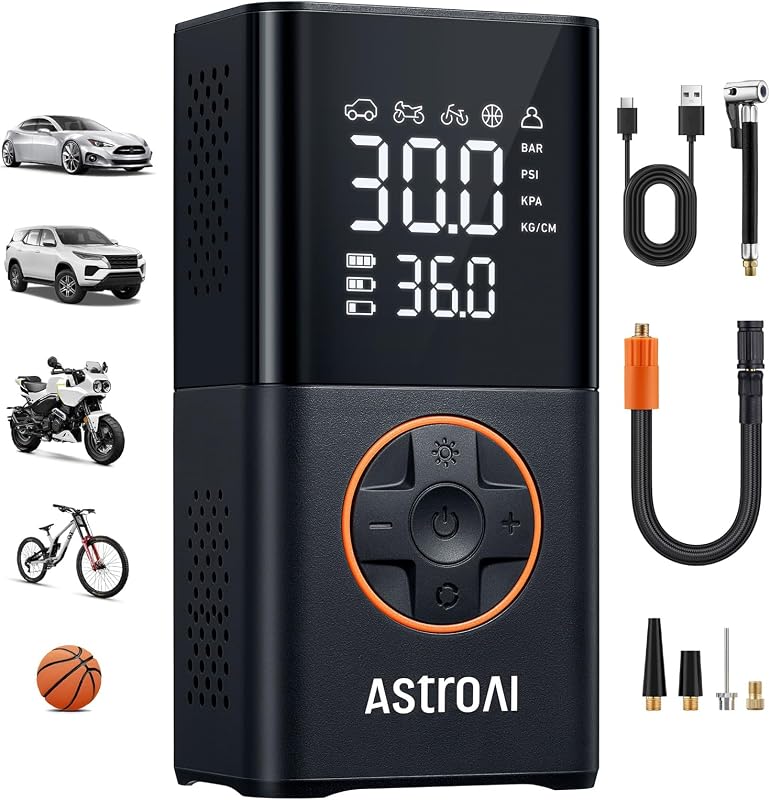
$24-45
A sub-one-pound pocket cordless inflator with digital PSI preset, auto shut-off, LED light and a 4000mAh battery good for up to 8 tires per charge.
Affiliate link
$30-40
The classic value corded inflator — plug into the car's 12V socket, set a target PSI, it auto-stops.
Affiliate linkThis is the spec people worry about and shouldn't. On any quality unit of either type, the digital preset auto-shutoff holds within roughly a couple of PSI of the number you set — set 36, walk away, and you'll find it stopped in the mid-30s. Fanttik cites reviewer measurements around ±1 PSI for the X8 APEX; the corded EPAuto's preset gauge lands in the same honest ballpark. In practice both are far more accurate than eyeballing a gas-station pump, and accuracy is not the axis that should decide corded vs cordless.
One habit closes the small gap that remains: check your finished pressure with a cheap standalone gauge the first time you use any new inflator, so you learn its offset. After that you can trust the preset.
Small compressors of both types make heat, and heat is what actually stops a fill on a big job. 'Duty cycle' is the share of time a compressor can run before it needs to cool — and budget listings almost never print it. It's why a cheap unit that breezes through one car tire may need a rest before the second, and why a dead-flat truck tire is the hardest thing you can ask of any pocket inflator.
A cordless unit hits a double wall here: the motor overheats and the battery drains at the same time, on the exact job that needs the most of both. A 12V corded compressor still gets hot, but it never runs out of energy, so if you let it breathe it will eventually finish. If you routinely inflate large tires, treat overheating — not max PSI — as the real limit, and lean corded.
If your garage already runs on a battery platform — Milwaukee M12, DeWalt 20V MAX — there's a cheaper good answer than either a fresh cordless or a corded unit: a bare-tool inflator that runs on batteries you already own. You skip paying for another built-in cell, you get swappable power (dead pack? snap in a fresh one and keep filling — the thing cordless units can't do), and platform batteries are usually bigger than a pocket inflator's.
DeWalt's 20V MAX inflator is the flexible example in our catalog: it runs off its own 20V pack, the car's 12V socket, or a wall outlet, so it covers the roadside emergency, the garage session and the home bike-tire job. The catch is that it's bulkier and the battery is sold separately — which is exactly why it only makes sense if you already live on the platform. If you don't own the batteries, ignore this path and choose corded vs cordless on the merits above.
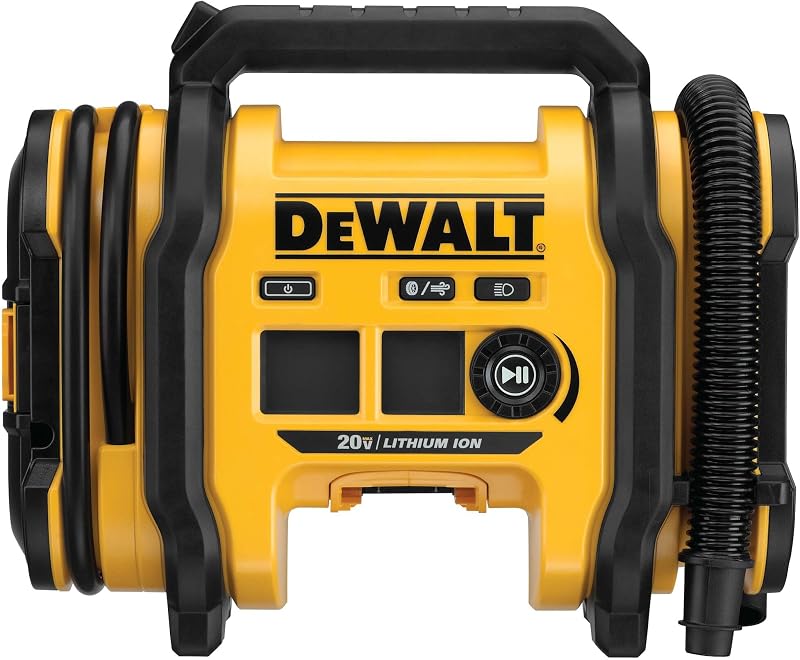
$99 (tool only)
A three-way inflator that runs off a DeWalt 20V MAX battery, a 12V car socket, or a 110V wall outlet.
Affiliate linkHow we work: specs verified against manufacturer documentation and listings, long-term owner feedback weighed, no personal lab testing claimed and no invented ratings. For the full head-to-head board with every spec side by side, see the tire-inflator comparison guide; for how these fit the rest of a trunk kit, the roadside kit guide maps the whole loadout.
$70-90
The flagship do-it-all cordless air compressor: dial in a target PSI, walk away, it auto-stops.
Affiliate link$24-45
A sub-one-pound pocket cordless inflator with digital PSI preset, auto shut-off, LED light and a 4000mAh battery good for up to 8 tires per charge.
Affiliate link$30-40
The classic value corded inflator — plug into the car's 12V socket, set a target PSI, it auto-stops.
Affiliate linkKeep cordless if your inflator's job is mostly topping up slow leaks and you want to grab it without cables or an idling engine. Keep a 12V corded compressor if you might face a dead-flat full-size truck or SUV tire, drive in cold winters, fill many tires, or don't want to maintain another battery — it runs off the car and never runs out of battery mid-fill, though it still needs rests on big jobs (AutoGuide: 10-minute recommended duty cycle).
It can, but it's the hardest job you can give one. Moving that much air makes a small motor run hot and drains a fixed battery fast — and a pack that's been sitting half-charged in the trunk may not finish. For dead-flat large tires, a 12V corded compressor's endless runtime is the safer tool.
Yes, in practice. Quality units of both types stop within roughly a couple of PSI of the preset — Fanttik cites reviewer measurements near ±1 PSI for the X8 APEX, and good corded units land in the same range. Verify with a cheap standalone gauge the first time to learn your unit's small offset, then trust it.
Run one with the engine on and it's a non-issue. With the engine fully off, a long fill pulls from the same battery that starts your car — so on a night with both a flat and a weak battery, keep the engine running or lean on a cordless unit instead.
Then a bare-tool inflator is usually the cheapest good option. You reuse batteries you already own, get swappable power (a fresh pack means you keep filling), and platform cells are typically larger than a pocket inflator's built-in battery.
Research-driven: our picks come from verified manufacturer specs and long-term owner feedback. How we work: our methodology.
The car, power, cooling, and work-utility gear worth owning — with the honest catch on each. One genuinely useful email a week. No spam, no fake reviews, unsubscribe anytime.