The Trunk Organizer That Doesn't Slide Around
Every trunk organizer promises order. Most of them just become a box that surfs the trunk on the first hard corner. The difference is one feature almost nobody checks.
The short answer
Trunk organizers slide because trunk floors are smooth carpet and most organizers are soft-sided boxes with nothing holding them down. The fix is an anchoring system: tie-downs, hook-and-loop strips, or rigid walls that brace against the trunk. The Drive Auto organizer combines reinforced walls with a tie-down anchor system — which is exactly why it's our pick.
Disclosure · As an Amazon Associate, BlackBox Supplies earns from qualifying purchases — at no extra cost to you. See our full disclosure.
Why they all slide
A trunk floor is low-pile carpet designed to be vacuumed, not to grip. Put a smooth-bottomed fabric box on it, add twenty pounds of gear, and physics does the rest: every corner sends it skating, every hard stop dumps it forward. The organizer didn't fail at organizing — it failed at staying put, which turns out to be the entire job.
This is the single most common complaint in long-term owner reviews across the category, and it's why 'has compartments' is the wrong shopping criterion. Compartments are table stakes. Anchoring is the product.
The three anchoring systems that work
- Tie-down straps or anchor points — The organizer connects to your trunk's cargo hooks or seat hardware. Strongest hold — the box becomes part of the car. This is what the Drive Auto design uses.
- Hook-and-loop floor strips — Velcro-style strips grip the trunk carpet directly. Effective on most carpeted floors, less so on rubberized or plastic liners.
- Rigid, braced walls — Stiff walls let the organizer wedge against the trunk's sides and keep shape under load, so even without straps it resists surfing. Soft duffel-style organizers can't do this.
Our pick, and why
The Drive Auto trunk organizer earns the slot on the two features this article exists for: reinforced collapsible walls that hold their shape loaded, and a tie-down anchoring system that actually fixes it to the trunk. It folds flat when you need the whole trunk back. Around $35–45, and it solves the complaint that fills every competitor's review section.
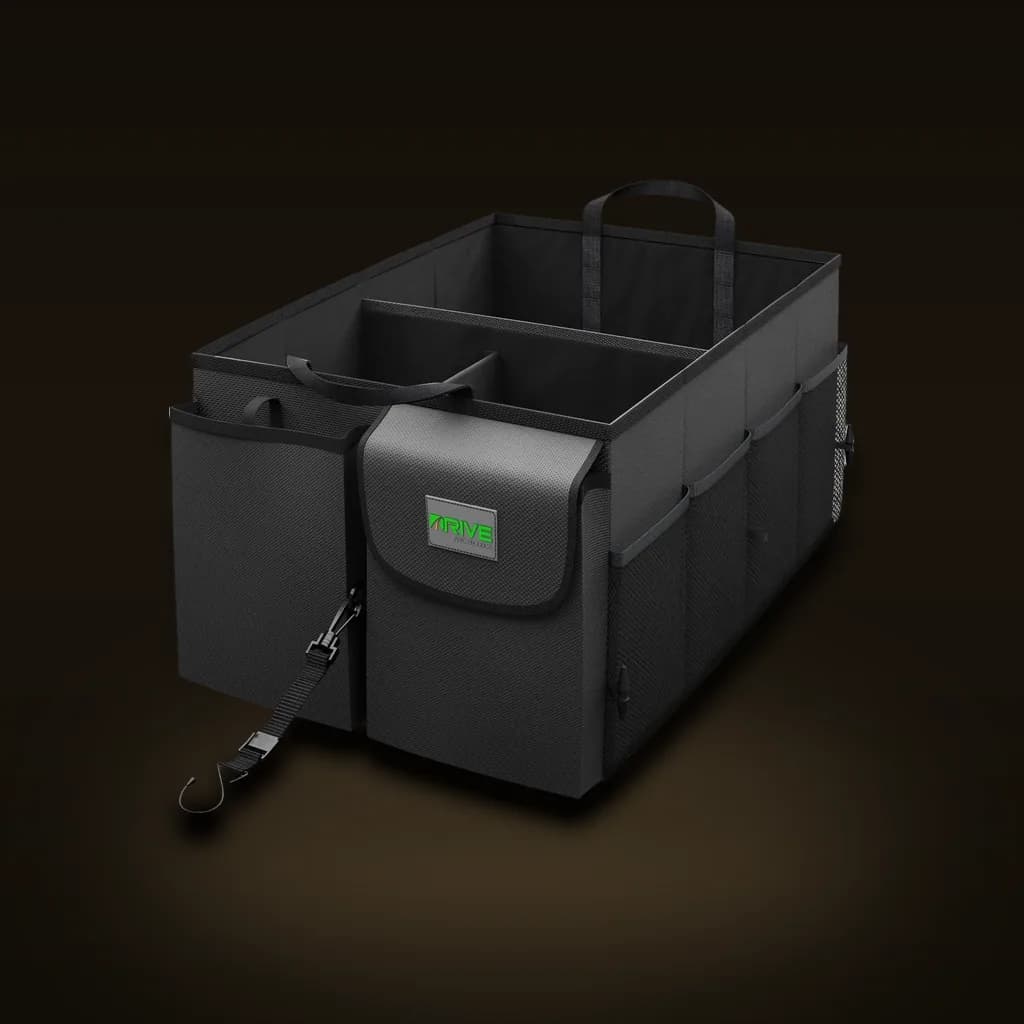
DRIVE Car Trunk Organizer (Collapsible, Multi-Compartment)
Drive Auto Products is the benchmark collapsible organizer: stiff panels that hold their shape, a waterproof lining, and straps that anchor to the trunk so it stops sliding, then folds flat when unneeded.
Affiliate linkIf you're evaluating any other organizer
- Anchor system present? — Straps, velcro strips, or anchor points. No anchoring, no purchase — that's the whole lesson.
- Walls that stand up loaded — Push a side wall in with a finger at the store. If it folds, so will your gear stack.
- Fold-flat design — Trunk space is shared space. A good organizer disappears when you need to haul something big.
- Sized to your actual trunk — Measure first. An organizer with six inches of slide room defeats its own anchors.
What actually belongs in it
An anchored organizer is the foundation of the roadside kit: jump starter, tire inflator, emergency light, and first-aid basics, each in a fixed spot instead of buried under grocery bags. We've mapped the full loadout — and the reasoning — in the roadside kit guide below.
Common questions
Do trunk organizers work in SUVs with flat cargo floors?
Yes — arguably better than in sedans, since most SUVs have exposed cargo tie-down points that strap-based anchor systems are designed for.
What about a milk crate or cardboard box?
They hold things, they don't hold position — and unlike a soft organizer, a rigid crate becomes a projectile in a hard stop. Anchoring is the feature you're paying for.
Keep reading
Car Gear Worth Keeping in Your Trunk
Beyond the emergencies, a handful of quality upgrades quietly make every drive better. These are the ones that earn their permanent spot in the car.
Read moreRoadside SafetyThe Roadside Emergency Kit: What Belongs in Your Trunk
You don't need a hundred-piece kit where ninety pieces are filler. You need the specific gear that covers the failures that actually happen. Here's the list.
Read moreThe gear actually worth buying — one email a week.
The car, power, cooling, and work-utility gear worth owning — with the honest catch on each. One genuinely useful email a week. No spam, no fake reviews, unsubscribe anytime.
- No spam
- One email a week
- Unsubscribe anytime